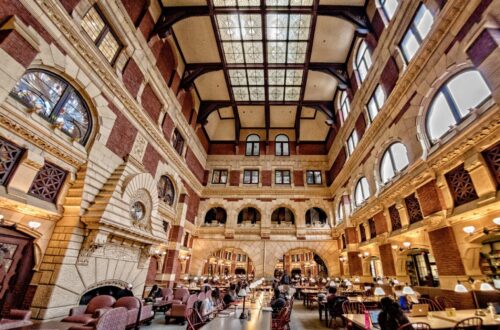


The University of Pennsylvania (Penn) is one of the most historic and distinctive universities in the United States. Located in Philadelphia, Pennsylvania, Penn combines the traditions of an Ivy League institution with an unusually strong emphasis on interdisciplinary education, entrepreneurship, professional preparation, and research. 🎓📚
Founded by Benjamin Franklin in 1740, Penn has a long history of connecting practical education with intellectual discovery. Franklin’s educational vision emphasized preparing students for useful lives in society rather than limiting education to classical subjects alone. That philosophy continues to influence the university’s character today.
Modern Penn brings together undergraduate colleges and renowned professional schools, including programs in business, engineering, nursing, communication, arts and sciences, design, education, law, medicine, and social policy.
For prospective students, this creates an exciting range of possibilities. A student might study economics while exploring entrepreneurship, combine biology with healthcare, investigate artificial intelligence and business, study political science alongside data science, or explore architecture while developing interests in sustainability.
Penn’s location also adds another dimension. Philadelphia is a major American city with a rich history, large healthcare sector, thriving cultural institutions, businesses, museums, restaurants, and numerous professional opportunities.
This guide explores what makes the University of Pennsylvania special, from its history and academics to campus life, research, admissions, financial aid, careers, and student experiences. 🌎✨
🏛️ The History and Legacy of the University of Pennsylvania
The history of Penn is closely connected to Benjamin Franklin.


Franklin helped establish an academy that eventually became the University of Pennsylvania. The institution developed a distinctive educational philosophy that placed importance on practical knowledge, scientific inquiry, communication, and preparation for civic life.
Penn’s history is therefore somewhat different from that of universities founded primarily around classical religious education.
From its early years, the institution developed an interest in fields that could have practical applications in society.
This tradition eventually contributed to Penn’s development as a comprehensive research university with strong professional education.
Today, the university is one of the eight institutions in the Ivy League and is widely recognized for its academic and research programs.
The university’s historical identity is still visible across campus.
Buildings, libraries, monuments, and traditions connect contemporary students with generations of scholars who studied at Penn before them.
One of the most recognizable landmarks is College Hall, whose towers have become an important symbol of the university.
Another famous campus area is Locust Walk, a pedestrian pathway that passes through the heart of campus and serves as a social gathering space for students.
Penn’s history also extends beyond Philadelphia.
The university’s alumni include scientists, business leaders, physicians, writers, government officials, entrepreneurs, artists, and other influential figures.
But history is only one part of Penn’s identity.
What makes the university particularly interesting today is how it combines tradition with experimentation.
Students have access to established academic disciplines while also encountering emerging fields such as artificial intelligence, biotechnology, data science, entrepreneurship, sustainability, and digital media.
That combination creates an environment in which students can respect traditional scholarship while exploring new ideas. 💡
📚 Academic Life at Penn
Penn offers undergraduate education through four undergraduate schools: the College of Arts and Sciences, the Wharton School, the School of Engineering and Applied Science, and the School of Nursing.


This structure gives students a wide range of academic options.
📖 College of Arts and Sciences
The College of Arts and Sciences provides a broad liberal arts and sciences education.
Students can explore humanities, natural sciences, social sciences, mathematics, languages, and interdisciplinary fields.
Subjects may include:
🧠 Psychology
📊 Economics
🧪 Chemistry
🧬 Biology
📖 English
🏛️ History
🌎 Political science
🧮 Mathematics
💻 Computer science
Students can develop depth within a major while also taking courses outside their primary discipline.
💼 Wharton School
Wharton is one of Penn’s most recognizable academic divisions.
Its undergraduate business program introduces students to areas such as finance, marketing, management, accounting, statistics, operations, entrepreneurship, and business analytics.
However, Wharton’s role within Penn extends beyond traditional business education.
The school’s proximity to other Penn programs allows students to explore connections between business and fields such as technology, healthcare, social impact, engineering, and the arts.
A student interested in healthcare entrepreneurship, for example, may find ways to combine business knowledge with biological sciences or engineering.
⚙️ Penn Engineering
The School of Engineering and Applied Science provides programs in engineering, computer science, biotechnology, materials, systems, and other technical areas.
Modern engineering increasingly requires collaboration across disciplines.
Artificial intelligence can connect computer science with healthcare and business.
Biomedical engineering can connect engineering with medicine.
Robotics can involve mechanical engineering, computer science, electrical engineering, and cognitive science.
Penn’s interdisciplinary environment supports these kinds of connections.
🩺 School of Nursing
Penn Nursing is another important component of the university.
Students interested in healthcare can explore nursing, health sciences, research, clinical practice, leadership, and healthcare policy.
The broader Penn ecosystem also creates opportunities to encounter medicine, business, engineering, and public health from multiple perspectives.
This interdisciplinary structure is one of Penn’s most attractive features.
🔗 Interdisciplinary Education: The Penn Advantage
One of the strongest reasons students choose Penn is the ability to cross academic boundaries.


Modern problems are rarely confined to one field.
Consider climate change.
Scientists can study environmental processes.
Engineers can develop clean technologies.
Economists can analyze incentives.
Business students can explore sustainable markets.
Political scientists can study regulation.
Designers can develop systems that encourage sustainable behavior.
A university that makes interdisciplinary learning accessible can help students understand these complex relationships.
Penn has developed a strong culture around this idea.
Students may be able to take courses across schools, participate in interdisciplinary research, join organizations with members from different majors, and collaborate on projects.
This creates possibilities that students might not have imagined when they first arrived.
A student who enters Penn intending to study finance may discover an interest in computer science.
A biology student might become interested in entrepreneurship.
An engineering student could develop an interest in healthcare policy.
A nursing student might become fascinated by health technology.
The university environment gives students room to experiment.
💡 College is not only about choosing a subject. It is also about discovering how different subjects connect.
🔬 Research at the University of Pennsylvania
Research is a major part of Penn’s identity.


As a major research university, Penn conducts research across many disciplines.
Research can involve medicine, engineering, business, neuroscience, psychology, economics, social policy, computer science, biology, chemistry, education, design, and the humanities.
Undergraduates can participate in research through faculty laboratories, independent projects, academic programs, internships, and research opportunities.
For students interested in graduate school or research careers, undergraduate research can be particularly valuable.
But research is not only useful for future scientists.
It can teach transferable skills.
Students learn how to:
🔎 Ask precise questions.
📊 Analyze information.
🧠 Evaluate evidence.
📝 Communicate findings.
🤝 Collaborate with others.
⚙️ Work through unexpected problems.
These skills are useful in business, journalism, law, medicine, government, technology, education, and many other professions.
🧬 Biomedical Research
Penn has an especially significant research ecosystem in medicine and biomedical science.
Its connections among undergraduate programs, Penn Medicine, nursing, engineering, and other academic areas create opportunities for interdisciplinary healthcare research.
Students interested in medicine may therefore encounter questions extending beyond clinical practice.
They might explore medical technology, healthcare economics, genetics, public health, bioethics, health policy, or data science.
🤖 Technology and Artificial Intelligence
Technology research is another growing area.
Artificial intelligence, machine learning, robotics, data analysis, cybersecurity, and computational science are influencing almost every industry.
Penn students can explore these technologies through computer science and engineering while also studying their social and economic implications.
The ability to understand both technology and its broader consequences is becoming increasingly valuable.
🏫 The Penn Campus
Penn’s campus is located in West Philadelphia and has a distinctive urban university character.


The campus combines historic Gothic architecture with modern academic and research buildings.
College Green provides an iconic campus landscape, while Locust Walk creates a pedestrian-centered environment where students regularly meet friends, attend events, and move between classes.
Penn’s urban setting is particularly appealing to students who want the traditional feel of a university campus while having access to a major city.
Philadelphia itself provides a rich cultural environment.
Students can explore:
🏛️ Historic landmarks
🎨 Art museums
🎵 Music venues
🍽️ Restaurants
🏀 Professional sports
🌳 Parks
📚 Libraries
🎭 Theatres
The city is also home to major hospitals, businesses, nonprofit organizations, government institutions, and cultural organizations.
This creates opportunities for internships, research, volunteering, and professional networking.
🌆 Philadelphia and Student Opportunities
Philadelphia is one of America’s oldest major cities and has a unique combination of history and modern urban life.


For Penn students, the city can function as an extension of the university.
A history student can visit historic sites.
An architecture student can study urban buildings.
A public policy student can observe local government.
A healthcare student can encounter major medical institutions.
A business student can explore companies and entrepreneurial organizations.
A communications student can investigate media organizations.
An environmental student can examine urban sustainability.
Philadelphia’s size also means students can experience many different communities and perspectives.
The city’s public transportation system provides connections between campus and different neighborhoods, while walking and cycling are also common in many parts of the university area.
The urban environment can be especially valuable for students who want to understand how cities operate.
Housing, transportation, education, public health, economic development, environmental policy, and community engagement are not merely academic concepts when students can observe them around them.
🐾 Student Organizations and Campus Life
Life at Penn extends well beyond academics.
Students can participate in hundreds of clubs, organizations, cultural groups, performance groups, athletic activities, publications, service initiatives, and professional societies.


There are opportunities for almost every interest.
🎭 Theatre
🎵 Music
📰 Student journalism
💻 Technology
💼 Entrepreneurship
🌎 International organizations
🤝 Community service
🏃 Athletics
🎨 Art
📚 Academic societies
Joining a student organization can be one of the easiest ways to build a social community.
Students often meet people from different majors through extracurricular activities.
A computer science student might join a business organization.
A Wharton student might participate in a social-impact project.
An engineering student might perform in a musical.
A nursing student might join a student publication.
These experiences can broaden perspectives.
🏆 Penn Athletics
Penn is also part of the Ivy League athletic tradition.
The university offers varsity sports and numerous recreational opportunities.
Students can support Penn teams, participate in intramural activities, or simply use campus athletic facilities.
Sports can create a sense of community and school spirit. 🏀🏃
🎨 Arts and Culture at Penn
The arts are an important part of campus life.
Students can participate in theatre, music, dance, visual arts, writing, film, and other creative activities.


Philadelphia’s cultural institutions add another layer.
Students can visit museums, attend concerts, explore galleries, watch theatre productions, and experience cultural festivals.
The combination of campus organizations and city institutions means students do not need to be majoring in the arts to enjoy a creative environment.
A science student can join an orchestra.
An economics student can take an art class.
An engineering student can perform theatre.
A history student can make films.
This is another example of interdisciplinary university life.
📝 Penn Admissions
Admission to Penn is highly competitive.
Prospective students should understand that there is no single formula that guarantees admission.
Strong academic preparation is essential, but successful applicants typically demonstrate more than excellent grades.
Penn looks for students who show intellectual curiosity, engagement, initiative, leadership, and a genuine interest in the opportunities offered by the university.


Students should take challenging courses appropriate to their circumstances and perform strongly.
But academics should be accompanied by meaningful activities.
A student might demonstrate commitment through:
🔬 Research
🎨 Creative work
⚽ Athletics
💻 Technology projects
🤝 Community service
🎵 Music
📰 Journalism
💼 Entrepreneurship
The strongest extracurricular profile is not necessarily the longest.
Instead, students should demonstrate authentic interest.
For example, someone passionate about entrepreneurship might build a small project, participate in competitions, mentor younger students, or create a community initiative.
Someone interested in science might conduct research or pursue independent experimentation.
Someone interested in social justice might spend significant time volunteering and developing community projects.
The goal is to demonstrate what the student actually cares about.
✍️ Writing the Application
Application essays provide an opportunity to explain the experiences behind accomplishments.
Students should avoid simply repeating their résumé.
Instead, essays can reveal:
What motivates you?
What challenge changed you?
What do you value?
How have your experiences shaped your goals?
Why does Penn fit those goals?
Specific examples usually make essays more compelling.
Rather than saying “I am passionate about medicine,” a student could describe a research experience, volunteer project, or personal learning experience that developed that interest.
Authenticity matters.
💰 Financial Aid and Affordability
The cost of attending an Ivy League university can initially appear substantial.
However, students should investigate Penn’s financial-aid policies rather than judging affordability solely by the published tuition price.


Penn provides need-based financial aid to eligible students, and its financial-aid programs have evolved over time to reduce barriers for students from different economic backgrounds.
Families should examine the latest official financial-aid policies, eligibility requirements, deadlines, and estimated costs.
The total cost of attendance can include:
🏫 Tuition
🏠 Housing
🍽️ Meals
📚 Books
💻 Technology
🚆 Transportation
🎒 Personal expenses
Students should compare the net cost after grants and scholarships rather than simply comparing sticker prices.
Families should also understand how financial aid may change if household circumstances change.
International students should review the specific policies that apply to them.
The most important principle is to research financial aid early.
🌍 International Students at Penn
Penn has an international community that contributes to the diversity of campus life.


Students from different countries bring different languages, cultural experiences, educational traditions, and perspectives.
This diversity can enrich classroom discussions and campus organizations.
International students can also participate in cultural associations, international student organizations, research, athletics, and other activities.
For students moving to the United States from another country, university life can involve an adjustment period.
Students may need to become familiar with:
📄 Visa requirements
🏠 Housing
💰 Financial planning
📚 Classroom expectations
🩺 Health services
🚆 Transportation
🗣️ Communication styles
Fortunately, international student offices and campus organizations can help students navigate these challenges.
Living and studying alongside students from different backgrounds can itself become an important educational experience.
💼 Career Development at Penn
Career preparation is an important component of the Penn experience.
The university’s schools provide career services, advising, networking opportunities, internship resources, and connections with employers.


Penn’s location in Philadelphia creates opportunities across many industries.
The city has a strong presence in:
🏥 Healthcare
💰 Finance
💻 Technology
⚖️ Law
📚 Education
🏢 Consulting
🎨 Arts and culture
🏛️ Government
🤝 Nonprofit organizations
Students can also access opportunities in nearby cities such as New York and Washington, D.C., depending on their field and career goals.
🚀 Entrepreneurship
Entrepreneurship is a particularly visible part of Penn culture.
Students interested in starting companies can connect with entrepreneurship programs, innovation communities, mentors, competitions, and fellow students.
The interdisciplinary nature of Penn can be particularly useful for entrepreneurs.
A successful startup may need:
💻 Technology
💼 Business
🎨 Design
📣 Marketing
⚖️ Legal knowledge
🧠 Behavioral insight
An entrepreneur who can collaborate across these fields may have a significant advantage.
🧪 Healthcare and Medicine
Penn has an unusually comprehensive healthcare ecosystem.
The university’s medical and nursing programs, along with its broader research institutions and healthcare organizations, create a major environment for medical discovery and education.


Students interested in healthcare can encounter many different perspectives.
Medicine focuses on clinical care.
Nursing emphasizes patient care and healthcare practice.
Engineering can contribute medical technologies.
Business can explore healthcare management.
Economics can analyze healthcare markets.
Public policy can examine healthcare access.
Biology can investigate disease mechanisms.
This interdisciplinary environment demonstrates how modern healthcare depends on many different professions.
Students considering medical careers can therefore explore healthcare from multiple angles before choosing a professional pathway.
🌱 Sustainability and Social Impact
Penn students can also explore sustainability and social impact.
Urban sustainability, climate change, renewable energy, environmental policy, food systems, and social entrepreneurship are increasingly important areas of study.


Students from different schools can approach sustainability from different perspectives.
Engineers may develop new technologies.
Business students can study sustainable business models.
Design students can explore sustainable architecture.
Scientists can research environmental systems.
Social scientists can examine behavior and policy.
This is another area where interdisciplinary education becomes particularly useful.
🧠 Balancing Academic Ambition and Well-Being
Penn provides an academically demanding environment.
Students often arrive with strong academic backgrounds and ambitious goals.
That can create an exciting intellectual culture, but it can also create pressure.
Learning how to manage time and maintain well-being is an essential part of university life.
Students should develop healthy routines that include:
😴 Adequate sleep
🏃 Physical activity
🤝 Social connections
📚 Organized study
🌳 Time outdoors
🎨 Hobbies
Taking breaks does not mean a student lacks ambition.
In fact, sustainable productivity often requires rest.
Students should also use university support resources when they need help.
Asking for academic, personal, or professional support is a normal part of university life.
🏙️ Living in Philadelphia
Living in a city provides opportunities that a suburban or rural campus might not.
Students can explore different neighborhoods, restaurants, museums, parks, cultural institutions, and professional environments.


Philadelphia is also deeply connected to American history.
Students can visit places associated with the founding of the United States, including Independence Hall and the Liberty Bell.
For history students, this creates an extraordinary learning environment.
But Philadelphia is not simply a historical city.
It is also a modern metropolitan area with technology companies, hospitals, universities, creative industries, financial institutions, startups, and nonprofit organizations.
This combination of history and innovation gives students many ways to engage with the city.
🎓 Life After Penn
Graduation represents the beginning of another stage.


Penn graduates pursue many different paths.
Some enter business.
Some become physicians.
Some become engineers.
Some attend law school.
Some pursue academic research.
Some become entrepreneurs.
Others work in government, education, journalism, nonprofit organizations, technology, entertainment, or the arts.
The university’s alumni community provides relationships that can continue long after graduation.
But perhaps one of the greatest benefits of a Penn education is not simply the degree.
It is the combination of:
📚 Knowledge
🔬 Research experience
🤝 Relationships
💡 Intellectual curiosity
💼 Professional preparation
🌎 Global perspective
These experiences can shape how graduates approach problems throughout their careers.
🌟 Why Choose the University of Pennsylvania?
There are many reasons students might consider Penn.
🏛️ Historic Ivy League Environment
Penn combines centuries of history with modern research and innovation.
🔗 Interdisciplinary Opportunities
Students can connect subjects across schools and academic fields.
💼 Strong Business Education
Wharton provides a major environment for students interested in business and entrepreneurship.
⚙️ Engineering and Technology
Penn Engineering offers pathways into modern technical fields.
🩺 Healthcare Ecosystem
Penn’s medical and nursing programs create an extensive healthcare environment.
🏙️ Philadelphia Location
Students gain access to a major American city.
🔬 Research
Undergraduate and graduate students can participate in research across numerous fields.
🤝 Diverse Student Community
Clubs and organizations allow students to meet people with different interests and backgrounds.
🚀 Entrepreneurship
Penn supports students interested in developing ideas and creating organizations.
Together, these characteristics make Penn a particularly flexible university for students who want to explore multiple directions.
🌈 Tips for Prospective Penn Students
Students considering Penn can take several steps before applying.
Research your intended school. 🎓
Learn about the College of Arts and Sciences, Wharton, Engineering, Nursing, or whichever program interests you.
Explore interdisciplinary opportunities. 🔗
Think about combinations of subjects you might want to study.
Visit campus if possible. 🏫
Walking around Locust Walk and College Green can provide a sense of the university environment.
Research Philadelphia. 🌆
Consider whether an urban campus is right for you.
Investigate financial aid. 💰
Understand the latest policies and calculate potential costs.
Develop meaningful activities. 🚀
Pursue interests because they matter to you.
Prepare your essays carefully. ✍️
Use specific experiences to communicate your personality and goals.
Talk to current students or alumni. 🤝
Their experiences can provide useful perspectives that websites cannot fully capture.
📝 Final Thoughts: Is Penn Right for You?
The University of Pennsylvania offers a distinctive combination of Ivy League tradition, research, interdisciplinary education, professional preparation, entrepreneurship, and urban opportunity.
Its Philadelphia location gives students access to a major American city, while the campus provides a strong university community.
Its academic structure allows students to explore different disciplines.
Its research ecosystem gives students opportunities to investigate important questions.
Its professional schools create connections between undergraduate education and fields such as business, engineering, nursing, medicine, law, education, and design.
And its student organizations provide opportunities to build friendships and pursue interests beyond the classroom. 🎓✨
For a prospective student, however, the most important question is not simply whether Penn is prestigious.
The more useful question is whether Penn fits your goals.
Ask yourself:
🎯 What do I want to study?
🔬 Do I want significant research opportunities?
💼 Am I interested in business or entrepreneurship?
⚙️ Do I want access to engineering and technology?
🩺 Am I interested in healthcare?
🔗 Do I want to combine different academic disciplines?
🏙️ Would I enjoy living in a major city?
🤝 What kind of community do I want?
💰 What financial plan is realistic for my family?
If your interests align with Penn’s academic culture and opportunities, the university can provide an extraordinary environment for intellectual and personal development.


Ultimately, the University of Pennsylvania is more than an Ivy League name.
It is a place where students can study traditional academic disciplines while exploring emerging fields, collaborate with people from different backgrounds, participate in research, engage with Philadelphia, build professional networks, and discover new ambitions.
Benjamin Franklin’s original vision emphasized education that could be useful to society. More than two centuries later, that idea remains relevant.
The challenges facing the modern world—artificial intelligence, healthcare, climate change, economic inequality, sustainability, urban development, and technological transformation—require people who can connect knowledge across disciplines.
Penn’s greatest strength may therefore be its ability to encourage students to ask not only “What do I want to learn?” but also “How can I use what I learn to make a difference?” 💡🌎
For students who value curiosity, collaboration, practical knowledge, research, and innovation, Penn can be an exceptional place to begin that journey. 🎓🏛️✨