There are universities that teach students what is already known, and then there are universities that encourage students to ask what could be possible next. The University of Pennsylvania, commonly known as Penn, belongs firmly in the second category.
Located in Philadelphia, Pennsylvania, Penn combines centuries of history with modern research, interdisciplinary education, entrepreneurship, professional preparation, arts, athletics, and a lively urban campus environment. Its roots stretch back to 1740, and the university describes itself as America’s first university.
Yet Penn is not simply defined by its history.
Walk through campus today and the atmosphere is remarkably contemporary. Students move along Locust Walk between classes, researchers work on ambitious questions in laboratories, entrepreneurs develop new ideas, artists perform and exhibit their work, and student organizations create communities around hundreds of different interests.
Penn’s undergraduate students can pursue more than 90 majors across four undergraduate schools, while the university’s 12-school structure creates opportunities for students and faculty to connect ideas across traditional academic boundaries.
That combination of tradition and experimentation gives Penn a distinctive personality.
🌟 It is a university where history provides the foundation, but curiosity points toward the future.
🏛️ A Historic University With a Modern Perspective
Penn’s history is closely connected with Philadelphia and the intellectual environment of the early United States.
The university traces its origins to 1740, and its story is strongly associated with Benjamin Franklin and his vision of practical, useful education.
That historical background remains visible throughout campus.
Architecture, pathways, courtyards, libraries, and historic buildings create a sense that students are walking through an institution with a long memory. At the same time, modern laboratories, classrooms, research facilities, innovation spaces, and technology-focused initiatives demonstrate that Penn is continuously changing.
This contrast is part of Penn’s appeal.
A student can study in a historic building and then participate in cutting-edge research. They can discuss centuries-old philosophical questions while also examining artificial intelligence, biotechnology, entrepreneurship, data science, or modern healthcare.
The campus itself becomes a reminder that education is a continuous conversation between the past and the future.
Penn’s official academic information describes its educational environment as grounded in the liberal arts and sciences while being enriched by its four undergraduate and 12 graduate schools.
This structure encourages students to look beyond the boundaries of a single subject.
History can inform public policy.
Psychology can influence business.
Engineering can contribute to healthcare.
Design can influence technology.
Business can help turn research into practical solutions.
Communication can determine whether an important discovery reaches the public.
💡 At Penn, knowledge is often most powerful when different kinds of knowledge meet.
📚 Four Undergraduate Schools, Many Possible Directions
One of the defining features of Penn’s undergraduate experience is the ability to explore multiple academic interests.
The university’s four undergraduate schools are the College of Arts and Sciences, the Wharton School, the School of Engineering and Applied Science, and the School of Nursing. Penn states that undergraduates can pursue more than 90 majors across these schools.
Each school provides its own academic identity.
The College of Arts and Sciences offers a broad liberal arts and sciences environment. Students can investigate subjects ranging from the humanities and social sciences to natural sciences and interdisciplinary fields.
The Wharton School is internationally recognized for business education and provides students with opportunities to study management, finance, marketing, entrepreneurship, analytics, and other areas.
The School of Engineering and Applied Science brings together engineering, computing, technology, design, and scientific problem-solving.
The School of Nursing focuses on health, clinical education, research, and the human side of healthcare.
Yet choosing one school does not necessarily mean living inside a single academic box.
Penn emphasizes interdisciplinary education, and its admissions materials explain that students have access to perspectives and opportunities across the four undergraduate schools.
That flexibility can create unusual academic combinations.
Imagine a student fascinated by healthcare who wants to understand both medicine and business.
Another student might love computer science but also want to study psychology.
Someone interested in sustainability might combine environmental science with economics.
An aspiring entrepreneur could develop technical knowledge while learning how organizations and markets operate.
🎯 The point is not simply to collect subjects. It is to understand how different areas of knowledge can work together.
🔬 Research That Connects Ideas to Real-World Problems
Research is at the heart of Penn’s identity as a major research university.
Penn reports a $1.33 billion research budget in 2026, more than 6,000 research faculty, and 209 research centers and institutes.
Those numbers reveal the scale of the university’s research environment, but the more interesting story is what researchers are trying to accomplish.
Research at Penn spans medicine, technology, business, science, humanities, social sciences, engineering, and many other areas. The university emphasizes not only generating new knowledge but also applying that knowledge to improve lives locally and globally.
This approach encourages a practical question:
What can we do with what we discover?
A scientific discovery might eventually influence healthcare.
A technological development might become a new product.
A social science study might improve understanding of communities.
A business research project might influence organizational decisions.
A design investigation might produce a better way of interacting with technology.
Research therefore becomes more than an academic exercise. It becomes a process for understanding problems and developing possibilities.
Penn’s Office of the Vice Provost for Research describes the university as home to more than 200 multidisciplinary centers and institutes and highlights its efforts to build bridges between traditionally separate research fields.
For students, that interdisciplinary environment can be inspiring.
They are not simply learning what researchers discovered decades ago.
They can observe how researchers ask questions today.
They can see uncertainty, experimentation, collaboration, and revision in action.
🔎 Research teaches students that not knowing the answer can be the beginning of something important.
🤖 Innovation and the Culture of Creating Something New
Penn’s academic culture is closely connected to innovation.
The university describes innovation as part of its broader ecosystem, with faculty and students working on cutting-edge ideas across fields.
Innovation can take many forms.
It can be a new scientific discovery.
It can be a startup.
It can be a new medical approach.
It can be an engineering design.
It can be a new educational method.
It can even be a new way of understanding a social problem.
One of Penn’s distinctive strengths is the way its academic ecosystem allows these forms of innovation to interact.
Entrepreneurship can connect business students with engineers.
Research can connect scientists with entrepreneurs.
Design can connect technology with human needs.
Healthcare can connect clinical knowledge with data and engineering.
💡 This creates an environment where students can move from idea → experiment → feedback → improvement.
That process is important even for people who never start a company.
Entrepreneurial thinking teaches students to identify problems, understand users, communicate ideas, manage uncertainty, collaborate with teams, and learn from unsuccessful attempts.
In a rapidly changing economy, these skills can be valuable in almost every profession.
🌆 Philadelphia as Part of the Educational Experience
Penn’s location is one of its defining advantages.
The university is located in Philadelphia, a historic American city with major cultural, medical, business, educational, and civic institutions.
Penn’s official student-life resources emphasize that the university is part of a vibrant urban ecosystem filled with history, arts, culture, and innovation.
For students, the city can function almost like an additional classroom.
A student studying political science can experience a major American city with complex civic institutions.
A business student can observe companies and economic activity.
A nursing student can learn within a major healthcare environment.
An architecture student can study historic and contemporary buildings.
An art student can explore museums and galleries.
A journalist can observe urban communities and public life.
An entrepreneur can interact with organizations and businesses.
The city also provides cultural opportunities.
Philadelphia’s museums, restaurants, parks, neighborhoods, theaters, music venues, historic sites, and public spaces create an environment where students can continue exploring after class.
🏙️ At Penn, the boundary between campus and city is naturally porous.
The university becomes part of Philadelphia, while Philadelphia becomes part of the student experience.
🌳 Locust Walk and the Rhythm of Campus Life
Every university has places that become symbolic of student life.
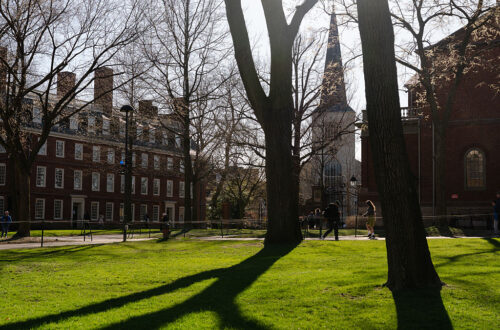
At Penn, Locust Walk is one of them.
The tree-lined pathway provides a central pedestrian route through campus and has long been associated with student movement, conversations, traditions, and community.
It is easy to imagine the daily rhythm.
A student leaves a residence hall.
They walk toward a morning class.
They stop to talk with a friend.
Someone is advertising a student organization.
Another group is heading toward a library.
A professor walks by.
A student rushes toward an afternoon meeting.
Later, the same pathway may become quieter as evening approaches.
These ordinary moments become an important part of university life.
Penn’s campus-life information highlights traditions such as walking Locust Walk, visiting Ben on the Bench, and cheering for the Quakers.
The university experience is not only composed of major achievements.
It is also built from small daily interactions.
☕ A coffee with a friend.
📖 An afternoon in the library.
🎭 A student performance.
🏀 An athletic event.
🌳 A conversation outdoors.
🎉 A campus tradition.
Those moments create memories that can last long after graduation.
🎭 Arts, Culture, and Creative Expression
A university known for research and professional education can sometimes be imagined as intensely career-focused.
Penn’s campus life offers a broader picture.
The university highlights arts and culture as important parts of student life, including museums, music, dance, theater, and student performances.
Creative experiences can provide an important counterbalance to academic pressure.
A student may spend several hours studying economics and then attend a concert.
An engineering student might participate in theater.
A nursing student might join a dance organization.
A computer science student might explore visual arts.
These experiences encourage students to develop identities beyond their majors.
Creativity also has educational value.
Art teaches observation.
Music teaches pattern and discipline.
Theater teaches communication.
Writing teaches clarity.
Design teaches iteration.
Performance teaches confidence.
🎨 The arts remind students that education is not only about solving problems. It is also about interpreting the world and expressing ideas.
🧑🤝🧑 Student Organizations and Finding Community
A university can offer enormous opportunities, but opportunities become meaningful when students find communities in which they feel comfortable participating.
Penn provides a wide range of social, political, artistic, multicultural, and other organizations. Its official life-at-Penn resources encourage students to participate in clubs and activities that match their interests and curiosity.
For a first-year student, joining a club can be a turning point.
Walking into a meeting can feel intimidating.
Then someone introduces themselves.
A conversation begins.
A shared interest becomes a friendship.
A few weeks later, the student may be helping organize an event.
Months later, they may be leading the organization.
This progression demonstrates how extracurricular activities can develop skills over time.
Leadership is learned through practice.
Communication improves through interaction.
Organization develops through responsibility.
Confidence grows when students realize they can contribute.
🤝 Student organizations can therefore become laboratories for personal development.
They also expose students to people from different academic backgrounds.
Someone from Wharton may collaborate with someone from Engineering.
A nursing student may work with a student from Arts and Sciences.
A graduate student may participate in an interdisciplinary project with undergraduates.
These interactions create the possibility of intellectual connections that might not occur inside a single classroom.
🏠 Residential Life and Everyday Belonging
University life also happens where students live.
Penn’s residential system provides students with spaces where academic and social experiences overlap.
The university’s Penn Experience initiative notes that every undergraduate lives for at least two years in one of 13 College Houses, with faculty, house directors, and resident advisors supporting residential communities.
Residential communities can make a large university feel smaller.
Students eat together.
Study together.
Celebrate birthdays.
Attend house events.
Discuss classes.
Share traditions.
Help one another during difficult weeks.
For students far from home, these communities can become especially important.
The transition to university involves learning how to manage time, responsibilities, relationships, and independence.
A supportive residential environment can make that transition easier.
🏡 A university becomes more than a collection of buildings when students begin to feel that particular spaces belong to their memories.
📖 Libraries as Places of Discovery
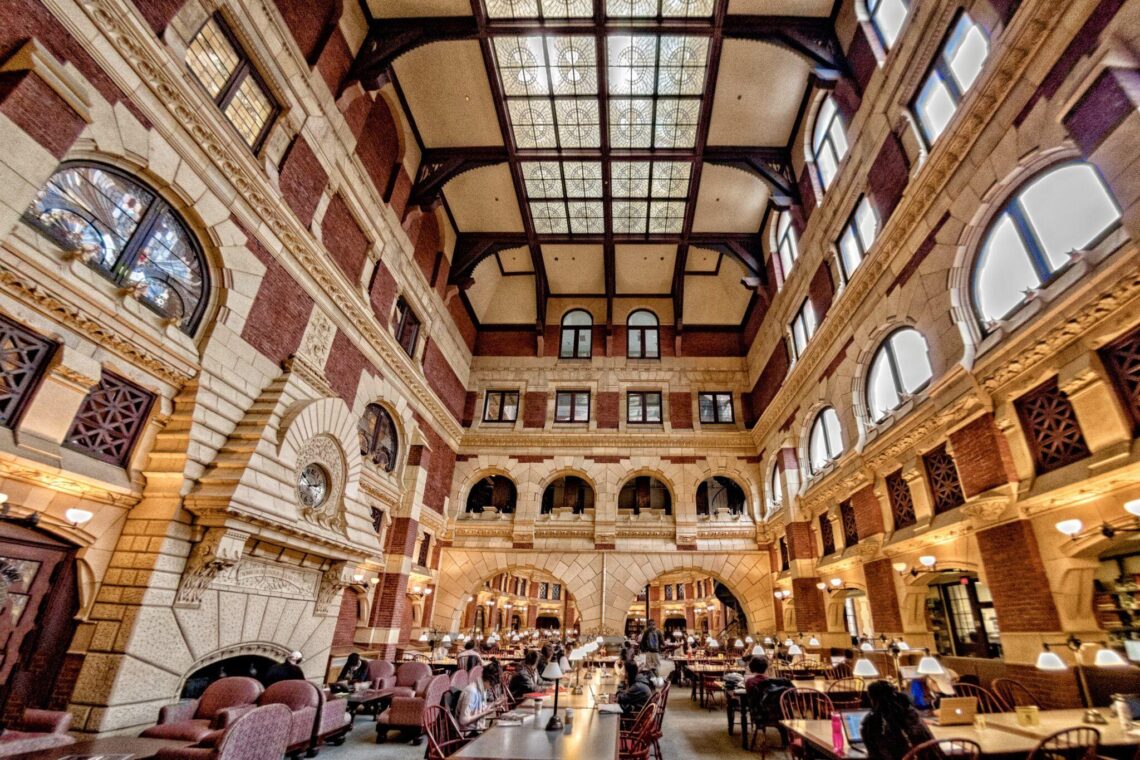
Libraries remain central to academic life at Penn.
The Penn Libraries provide research collections, specialized resources, research guides, online exhibits, and other academic services.
A library can be a place for focused work, but it can also be a place where unexpected discoveries happen.
A student searching for one source may find another.
A researcher may encounter an archival collection that changes the direction of a project.
A graduate student may spend months developing a dissertation.
A first-year student may simply find a quiet desk before an exam.
Libraries support all these experiences.
The Van Pelt-Dietrich Library Center is one of the recognizable academic spaces on campus, providing students with places to study and access research resources.
📚 In an increasingly digital world, physical libraries remain valuable because they create environments dedicated to concentration, scholarship, and intellectual exchange.
🌍 Global Perspectives at Penn
Penn’s influence extends well beyond Philadelphia.
The university describes itself as increasingly global and provides opportunities for students to engage with the world through courses, internships, research projects, study abroad, service learning, and other international experiences.
Global learning can change the way students understand familiar issues.
Healthcare looks different across countries.
Education systems vary.
Businesses operate within different cultural contexts.
Environmental challenges cross borders.
Technology affects societies differently.
Political institutions differ.
🌎 Exposure to these differences encourages students to become more thoughtful about assumptions they might otherwise take for granted.
International experience does not necessarily mean traveling thousands of miles.
A globally diverse university community can itself provide opportunities for cross-cultural learning.
Students can meet classmates from different countries, participate in international organizations, study global issues, and work on projects involving communities beyond the United States.
Penn Global describes opportunities that connect passion and knowledge with communities around the world.
This reflects an important idea:
Knowledge becomes more powerful when it can move across borders.
🩺 Health, Wellness, and Student Support
Academic ambition is important, but students also need support for their physical and emotional well-being.
Penn provides student services covering health, wellness, academic resources, communities, residential life, employment, and other areas.
The university’s Student Health and Counseling services include confidential professional mental health care for students, with services such as individual and group therapy, crisis intervention, workshops, and psychological testing.
Wellness is not separate from academic success.
A student who can manage stress, build healthy routines, seek help, and maintain meaningful relationships is better positioned to participate fully in university life.
That does not mean university life is always easy.
Penn is academically demanding, and students may encounter pressure, uncertainty, and periods of intense work.
The availability of support matters because asking for help should be understood as part of responsible self-management rather than a sign of weakness.
💙 A healthy university culture recognizes that students are people first and scholars second.
🏃 Athletics and the Quaker Spirit
Athletics add another layer to campus identity.
Penn is a member of the Ivy League and offers opportunities for students to participate in competitive sports, recreation, and fitness activities.
For student-athletes, sports can demand discipline, teamwork, time management, and resilience.
For spectators, athletic events can create shared traditions.
🏀 A crowded arena.
🏃 A race on campus.
🎉 Students cheering together.
🐾 The excitement of supporting the Quakers.
These experiences create connections between students who might otherwise never meet.
Recreation also matters for students who are not varsity athletes.
Exercise can provide a break from studying, a way to meet people, and an opportunity to maintain physical health.
A balanced university experience includes both intellectual effort and physical activity.
🌱 Sustainability and the Future of Campus
Universities are increasingly thinking about how campuses can become more sustainable.
Penn states that it is dedicated to promoting a sustainable culture and implementing environmentally conscious policies.
A university campus is a useful place to explore sustainability because it functions like a small community.
Thousands of people study, work, eat, travel, live, and conduct research in one environment.
Questions about energy, transportation, food, buildings, waste, water, and landscape therefore become practical rather than theoretical.
🌱 Students can learn about sustainability while seeing the challenges firsthand.
This also creates opportunities for interdisciplinary thinking.
Engineers can explore efficient technologies.
Designers can consider sustainable buildings.
Business students can examine environmental economics.
Scientists can study ecological systems.
Policy students can investigate environmental governance.
The challenge of sustainability demonstrates once again why interdisciplinary education matters.
Complex problems rarely fit neatly into one academic department.
💡 Learning to Turn Knowledge Into Action
Perhaps one of Penn’s most interesting educational characteristics is its emphasis on connecting knowledge with action.
The university describes its research mission around generating new knowledge and applying it to improve lives.
Its academic materials similarly emphasize hands-on education, research, and preparing students to apply their learning in the world.
This creates an educational philosophy that can be summarized simply:
Learn. Question. Create. Apply.
A student does not have to wait until graduation to begin making connections between education and real-world problems.
A class project can investigate a community issue.
A research project can explore an unanswered question.
A student organization can organize a service initiative.
An internship can provide professional experience.
An entrepreneurial project can test a new idea.
A design project can address a human need.
🚀 Education becomes active when students are given opportunities to do something with what they learn.
🎯 The Penn Experience: More Than a Major
Choosing a university is often presented as a question of academic rankings or famous programs.
Those factors matter, but the deeper question is:
What kind of person will I become in this environment?
Penn offers a setting where students can encounter rigorous academics, ambitious research, professional education, arts, athletics, entrepreneurship, global perspectives, and an urban community.
Its four undergraduate schools provide different academic homes, while the university’s integrated campus encourages cross-school interaction.
The result is a place where students can develop more than technical knowledge.
They can learn to communicate.
They can learn to collaborate.
They can learn to question assumptions.
They can learn to manage uncertainty.
They can learn to lead.
They can learn to listen.
They can learn to create.
They can learn to adapt.
And perhaps most importantly, they can learn that their education does not have to follow a predetermined script.
🌟 There is more than one way to build a meaningful future.
🌇 Why Philadelphia and Penn Work So Well Together
The relationship between Penn and Philadelphia deserves special attention.
Some universities feel separated from their surrounding cities.
Penn is deeply embedded in its urban environment.
The university contributes students, research, healthcare, innovation, arts, and community engagement to Philadelphia. At the same time, the city provides students with experiences that cannot be recreated inside a campus boundary.
Students can learn from the city’s history.
They can observe its neighborhoods.
They can participate in community initiatives.
They can discover its cultural institutions.
They can build professional relationships.
They can simply enjoy being young in a large city.
That relationship makes Penn feel simultaneously like a university and a city community.
✨ A Final Look at the University of Pennsylvania
The University of Pennsylvania is difficult to describe with a single adjective.
It is historic, but not stuck in the past.
It is academically rigorous, but not limited to one kind of knowledge.
It is research-intensive, but also entrepreneurial and practical.
It is professional, but deeply connected to liberal arts and sciences.
It is urban, yet filled with green spaces, pathways, courtyards, and distinctive campus traditions.
It is large enough to offer extraordinary possibilities while creating smaller communities through schools, residential houses, clubs, teams, research groups, and shared interests.
From its origins in eighteenth-century Philadelphia to its modern research programs, Penn represents an ongoing experiment in what higher education can accomplish.
Its greatest strength may be the connections it makes possible.
Connections between disciplines.
Connections between students and faculty.
Connections between research and real-world problems.
Connections between Philadelphia and the campus.
Connections between history and innovation.
Connections between professional ambition and personal curiosity.
💙❤️ Penn is ultimately a place for people who want to explore what happens when knowledge is not treated as an endpoint, but as a starting point.
For one student, that journey might begin in a library.
For another, it could begin in a laboratory.
Someone else may find inspiration on Locust Walk, in a classroom, at an athletic event, inside a student organization, or while exploring Philadelphia.
The paths are different, but the underlying idea remains the same: education becomes meaningful when curiosity turns into action.