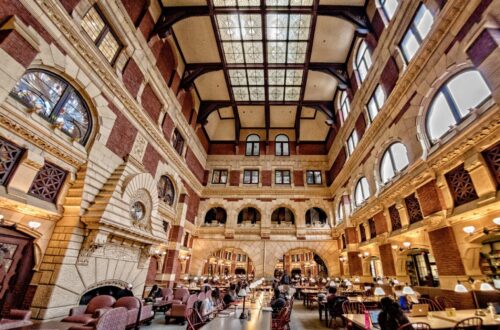


The University of Pennsylvania, commonly known as Penn or UPenn, is one of the most recognizable universities in the United States. Located in the heart of Philadelphia, Pennsylvania, Penn combines a long academic tradition with an energetic urban environment, interdisciplinary education, ambitious research, and a diverse student community. 🎓🏛️
Founded in 1740 and closely associated with Benjamin Franklin, Penn describes itself as America’s first university. Today, it operates as a major Ivy League research institution with undergraduate, graduate, and professional programs spanning fields such as business, engineering, nursing, medicine, law, communication, design, education, social policy, veterinary medicine, and the liberal arts.
For prospective students, Penn can be especially appealing because academic exploration does not have to remain inside a single discipline. Undergraduate students choose one of four undergraduate schools as their academic home base—the College of Arts and Sciences, the School of Engineering and Applied Science, the School of Nursing, or the Wharton School—but Penn emphasizes opportunities to explore subjects across schools.
Beyond classrooms and laboratories, the Penn experience includes student organizations, athletics, community engagement, cultural activities, internships, global opportunities, and life in Philadelphia. 🌎📚 Whether someone is interested in entrepreneurship, medicine, technology, economics, humanities, social sciences, or interdisciplinary research, Penn offers an environment designed to connect ideas with practical applications.
🏛️ The History and Legacy of the University of Pennsylvania
Penn’s history is one of its most distinctive characteristics. The university traces its origins to 1740, making its story deeply connected to Philadelphia and the intellectual atmosphere surrounding the founding of the United States. Benjamin Franklin played an important role in developing the educational vision that eventually became Penn.
Franklin’s educational philosophy emphasized practical knowledge and preparation for public life. Rather than treating education as purely theoretical, the institution developed around the idea that learning should help students understand the world and contribute to society. That spirit remains visible in Penn’s modern emphasis on research, professional education, entrepreneurship, interdisciplinary study, and community engagement. 💡


Penn’s West Philadelphia campus provides a visual connection between past and present. Historic buildings stand alongside modern research facilities, libraries, residence halls, laboratories, and academic spaces. College Hall, completed in 1871, was the first building on Penn’s West Philadelphia campus and originally housed many university functions, including classrooms, laboratories, offices, and the library.
The combination of historic architecture and modern facilities contributes to Penn’s distinctive atmosphere. Students can walk through areas that reflect more than a century of university development while simultaneously participating in cutting-edge research and contemporary academic programs.
The university’s history also influences its institutional identity. Penn is an Ivy League institution, but its character is not defined solely by tradition. The university presents itself as a place where students are encouraged to experiment, collaborate, pursue ambitious ideas, and connect academic knowledge with real-world challenges. 🚀
This balance between heritage and innovation is one reason Penn continues to attract students interested in both established disciplines and emerging fields.
📚 Academic Life at Penn: Interdisciplinary Learning
Academic flexibility is one of the most important aspects of the Penn experience. The university has four undergraduate schools, each offering a different academic focus while remaining part of the same campus community.
The College of Arts and Sciences provides a broad liberal arts and sciences education. Students can study subjects ranging from economics and psychology to biology, history, mathematics, political science, philosophy, languages, and the natural sciences. The College is also an important foundation for interdisciplinary study.
The School of Engineering and Applied Science focuses on engineering, computing, technology, and scientific innovation. Students interested in artificial intelligence, computer science, bioengineering, electrical engineering, mechanical engineering, data science, and related disciplines can find opportunities to connect technical knowledge with broader societal questions. 🤖💻
The School of Nursing prepares students for careers in healthcare while incorporating scientific knowledge, clinical education, leadership, and evidence-based practice. Nursing students can engage with Penn’s broader healthcare ecosystem and interdisciplinary environment.
The Wharton School is particularly well known for business education. Students explore areas such as finance, management, marketing, entrepreneurship, accounting, operations, economics, and business analytics. Wharton also provides opportunities to connect business education with technology, social impact, healthcare, and other fields.


What makes Penn particularly interesting is that students are not necessarily confined to the academic boundaries of their home school. Penn’s admissions materials emphasize that students can take courses across the four undergraduate schools, pursue interschool minors, and explore options such as additional degrees or interdisciplinary programs.
This approach can be valuable for students whose interests do not fit neatly into one category.
Imagine a student interested in healthcare technology. They might combine biology with computer science, explore entrepreneurship through Wharton, and participate in research involving medicine or engineering. Another student interested in climate policy could combine economics, environmental science, political science, and data analysis.
This kind of academic combination is increasingly important in a world where major challenges rarely belong to a single discipline. 🌱🌍
Penn’s academic philosophy therefore encourages students to become comfortable crossing boundaries between subjects. Instead of asking only, “What major should I choose?”, students can also ask, “What problems do I want to understand, and which disciplines can help me solve them?”
🔬 Research, Innovation, and Discovery
Research is central to Penn’s identity as a major research university. Students and faculty work across medicine, engineering, technology, business, science, social sciences, humanities, and numerous interdisciplinary fields. Penn reports more than 200 multidisciplinary research centers and institutes and more than $1.3 billion in total research awards.
For students, research can provide an opportunity to move beyond textbooks and lectures. Instead of simply learning what researchers have already discovered, students can participate in projects where questions may not have straightforward answers.


Penn Admissions highlights opportunities for students to participate in research in settings ranging from laboratories and classrooms to community organizations and healthcare environments. The university reports annual research funding exceeding $966 million on its admissions research page, while its broader institutional research figures report more than $1.3 billion in research awards for 2026.
The scale of Penn’s research environment means that students may encounter research questions involving artificial intelligence, medicine, public health, engineering, economics, psychology, sustainability, communication, education, and many other areas.
Research can also teach skills that are valuable beyond academia. Students learn how to formulate questions, evaluate evidence, interpret data, collaborate with other researchers, communicate findings, and handle uncertainty. 🧪📊
Innovation is another important part of Penn’s culture. The university supports entrepreneurship and programs designed to help students transform ideas into projects, organizations, or ventures.
For example, Penn’s President’s Innovation Prize supports graduating seniors or teams of graduating seniors seeking to develop innovative ventures that can make a positive difference.
This reflects a broader philosophy: an idea does not have to remain on paper. Students can experiment, build prototypes, conduct research, launch initiatives, and explore ways to create measurable impact.
🌆 Campus Life in Philadelphia
One of Penn’s biggest advantages is its location. The university is situated in West Philadelphia, giving students access to a large American city while maintaining a recognizable campus environment.


The campus includes historic buildings, green spaces, pedestrian paths, libraries, classrooms, laboratories, residence halls, dining facilities, athletic spaces, and student activity areas. Locust Walk is one of the most recognizable pedestrian routes through campus and serves as a social space where students move between classes, meet friends, attend events, or simply take a break.
The urban location adds another dimension to student life. Philadelphia is a major city with museums, restaurants, cultural institutions, hospitals, businesses, nonprofits, public organizations, and professional opportunities. 🏙️
Students can therefore experience a combination of campus-centered community and metropolitan life.
Philadelphia also provides a useful setting for students interested in community engagement. Penn reports more than 120 academically based community service courses each year and says approximately 14,000 students, faculty, and staff participate in more than 300 volunteer and community-service programs.
Community engagement can take many forms, including education, healthcare, nonprofit work, youth programs, civic activities, and public service.
This relationship with West Philadelphia is important because a university does not exist separately from its surrounding community. Students can learn about real social challenges while also contributing their time and skills.
For many students, these experiences can make education feel more meaningful. A sociology course can connect with community research. A nursing student can encounter real healthcare challenges. An engineering student can explore technology designed for practical applications. A business student can work with an organization addressing social needs.
The city becomes another classroom. 📖🏙️
🧑🎓 Student Community and Extracurricular Opportunities
University life is not only about grades and exams. At Penn, students can participate in a wide range of organizations, activities, athletics, cultural groups, professional societies, publications, performance groups, volunteer projects, and recreational programs.
The university’s large academic community brings together students with different interests, backgrounds, and goals. Penn reports 29,384 total students for Fall 2025, including undergraduate and graduate/professional students.


8
A student interested in entrepreneurship might join an innovation organization. Someone passionate about public service could participate in community programs. A future researcher could join a laboratory. Students interested in the arts can participate in performances, music, writing, or visual arts. Sports enthusiasts can compete at varsity or club levels.
Penn also has a long athletic tradition. The university is a charter member of the Ivy League and offers varsity competition across numerous men’s and women’s sports. During the 2024–25 academic year, Penn reported 2,734 team members participating in 30 leagues and tournaments, along with 1,166 students involved in 35 active club sports.
🏀 🏃♀️ 🏊♂️ ⚽ 🎾
Athletics can provide a valuable counterbalance to demanding academic schedules. Team environments encourage communication, discipline, leadership, resilience, and time management.
Student organizations offer another way to build relationships. For many students, some of their strongest friendships may develop outside classrooms through shared interests and collaborative projects.
Campus traditions also contribute to the feeling of belonging. Events, performances, student gatherings, athletic competitions, and social activities give students opportunities to celebrate together.
🌍 Global Opportunities and International Perspectives
Modern education increasingly requires students to understand perspectives beyond their immediate surroundings. Penn provides opportunities for students to study internationally and engage with global communities.
According to Penn’s institutional facts, 1,624 Penn U.S. citizen and permanent-resident students participated in study-abroad programs for academic credit during 2023–24, with programs spanning 68 countries.


Studying abroad can change the way students understand familiar subjects. Economics may look different when studied in another market. Public health challenges vary between countries. Architecture responds to different cultures and environments. Political science becomes more nuanced when students encounter different political institutions.
International experiences can also develop personal skills. Students must navigate unfamiliar environments, communicate across cultural differences, and become more independent.
Penn’s international community contributes to this perspective even for students who remain in Philadelphia. Institutional data reports thousands of international students enrolled across Penn’s programs, representing regions throughout the world.
This diversity can make everyday campus conversations more globally oriented. 🌎🤝
A classroom discussion may include perspectives from several countries. A student organization may organize an international cultural event. A research team may collaborate across borders. These interactions help students recognize that complex problems require multiple perspectives.
💰 Financial Aid and Affordability
The cost of attending an elite private university can be an important consideration for families. Penn therefore places significant emphasis on financial aid.
Penn states that undergraduate financial aid is based on financial need and that the university is committed to meeting 100% of demonstrated financial need with grants and work-study funding.
For the 2025–26 academic year, Penn lists undergraduate tuition and fees at $71,236, with room and board fees of $19,876. These figures demonstrate why prospective students should carefully investigate financial aid rather than judging affordability solely by the published tuition price.
Financial planning should begin well before enrollment. Families can review Penn’s financial-aid policies, understand the application requirements, estimate expected costs, and compare the final financial-aid offer with other universities.
💡 A strong college decision is not simply about choosing the institution with the highest ranking. It is about finding an academic environment that matches the student’s interests while also making financial sense for the family.
For international students, financial planning may require additional consideration because costs can include travel, insurance, visas, housing, and other expenses.
📝 Understanding Penn Admissions
Admission to Penn is highly competitive. For the Fall 2025 entering class, Penn reports receiving 72,544 applications and offering admission to 3,570 applicants, approximately 5 percent of the applicant pool.
This level of competition means that strong academic performance alone does not guarantee admission.
Prospective students should approach the application as an opportunity to communicate who they are rather than simply listing achievements. Academic preparation remains important, but so do intellectual curiosity, meaningful activities, personal development, community involvement, and the ability to explain why Penn fits their goals.


Penn’s undergraduate applicants choose one of four undergraduate schools—or certain coordinated dual-degree, accelerated, or specialized programs—as their academic home base.
This makes it important for applicants to understand the academic character of their intended school.
A student applying to Wharton should be able to explain why business education fits their interests. An engineering applicant should understand the type of engineering education they want. A nursing applicant should be prepared to discuss their interest in healthcare. A College applicant should be able to articulate their academic curiosity across the liberal arts and sciences.
The strongest applications usually demonstrate genuine alignment rather than attempting to imitate what an applicant thinks an admissions committee wants to see.
Authenticity matters. ✨
Students should also research Penn carefully before applying. Visiting campus, attending virtual events, exploring academic departments, reading faculty profiles, learning about student organizations, and speaking with current students can help applicants determine whether Penn genuinely fits their goals.
🧠 The Penn Approach to Career Preparation
A university education should prepare students not only for their first job but also for a changing professional world.
Penn’s interdisciplinary environment can support this preparation because modern careers increasingly cross traditional boundaries. Technology influences finance. Data influences healthcare. Design affects business. Psychology informs marketing. Public policy affects engineering. Entrepreneurship connects nearly every sector.
Students can use Penn’s academic resources to build combinations of knowledge that reflect these changing career patterns.
For example, someone interested in technology entrepreneurship might combine computer science with business. A student interested in healthcare management might combine healthcare knowledge with economics or management. A future policy analyst might combine political science with statistics and economics.
💻📈🩺🌎
Career preparation also happens outside the classroom. Internships, research projects, student organizations, community engagement, competitions, leadership roles, and networking can all contribute to professional development.
Penn’s alumni network is another potential resource. Graduates work across business, healthcare, technology, government, academia, nonprofit organizations, media, law, science, and many other fields.
The goal is not simply to collect credentials. Students should ideally leave Penn with the ability to think critically, communicate effectively, collaborate with different people, adapt to unfamiliar situations, and continue learning throughout their careers.
🌱 Community Engagement and Social Impact
One of Penn’s distinctive characteristics is its relationship with Philadelphia. Community engagement provides students with opportunities to connect academic knowledge to local needs.
Penn’s Netter Center for Community Partnerships and other university initiatives support academically based community service and civic engagement. The university reports more than 120 academically based community-service courses each year.


For students, community engagement can offer a different kind of education. A lecture might explain educational inequality, but working with a community organization can reveal the complexity behind the statistics.
Likewise, public health students can learn about healthcare disparities while working with community partners. Business students can explore nonprofit management. Education students can interact with local schools.
These experiences can challenge assumptions and develop empathy.
Social impact also extends beyond Philadelphia. Penn students and faculty participate in projects addressing global issues involving health, technology, sustainability, education, economics, and human rights.
The larger lesson is that academic excellence and social responsibility do not have to be separate concepts. 📚❤️
Knowledge becomes especially powerful when it can be used responsibly to improve communities.
🏫 Libraries, Learning Spaces, and the Everyday Academic Experience
Libraries remain an important part of university life even in an increasingly digital world.
Penn reports millions of physical books and extensive digital collections across its library system. For Academic Year 2026, Penn lists approximately 6.94 million print book volumes, 3.46 million e-books, and 377,832 e-journals.


Students may use libraries for quiet study, research, group projects, writing, presentations, or simply finding a comfortable place to work between classes.
The physical environment matters because university learning happens through many different routines. Some students prefer silent study rooms. Others work best in groups. Some enjoy studying outdoors when the weather is pleasant.
Penn’s campus provides a variety of spaces where students can develop their own study habits.
Learning also happens through conversations. A discussion with a professor after class can lead to a research opportunity. A conversation with another student can introduce a completely different perspective. A student organization meeting can inspire a new career idea.
In this sense, university education extends beyond formal coursework.
🚀 Why Penn Continues to Attract Ambitious Students
The University of Pennsylvania brings together several characteristics that make it attractive to ambitious students: Ivy League academics, research opportunities, interdisciplinary study, professional schools, a major-city location, international perspectives, community engagement, and a strong culture of innovation.
Its scale also provides unusual possibilities. Students can move between disciplines and encounter classmates preparing for careers in very different areas.
A computer science student might collaborate with a business student. A nursing student might interact with engineers developing healthcare technology. An economics student might work with political scientists. An artist might collaborate with designers and technologists.
That kind of environment can encourage intellectual curiosity. 🤝💡
Penn also emphasizes the practical application of knowledge. Research is not presented as something that belongs only to professors. Students can participate in research and community projects, while entrepreneurship programs encourage them to turn ideas into action.
This combination of theory and practice can be especially valuable in a rapidly changing world.
🌟 Final Thoughts: Is the University of Pennsylvania Right for You?
The University of Pennsylvania is much more than an Ivy League name. It is a large research university with a distinctive interdisciplinary structure, historic campus, urban location, broad academic offerings, and extensive opportunities for research and community engagement.


For students considering Penn, the most important question is not simply whether the university is prestigious. The better question is whether its academic philosophy, culture, location, resources, and opportunities align with personal goals.
Students who enjoy exploring multiple subjects may appreciate Penn’s interdisciplinary approach. Those interested in research can benefit from a large research ecosystem. Entrepreneurs can explore innovation opportunities. Future healthcare professionals can take advantage of connections among medicine, nursing, engineering, and other fields. Students passionate about public service can engage with Philadelphia and communities around the world.
Penn can also be demanding. The academic environment is highly competitive, and students need strong time-management skills, resilience, curiosity, and a willingness to ask for help when necessary.
Ultimately, the Penn experience is shaped not only by the university itself but by what each student chooses to do with the opportunities available.
🎓 Penn offers the resources. Students bring the curiosity.
From historic College Hall to modern research laboratories, from Locust Walk to Philadelphia’s wider neighborhoods, the University of Pennsylvania creates an environment where education can extend far beyond the traditional classroom.
For a student ready to explore ideas, challenge assumptions, collaborate across disciplines, and connect knowledge with real-world impact, Penn represents an extraordinary academic journey. 🌎📚💡