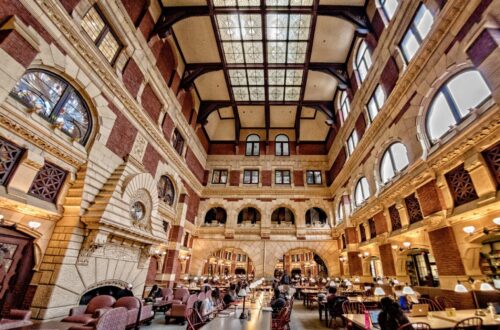


The University of Pennsylvania (Penn) is one of America’s most historic and influential universities. Located in Philadelphia, Pennsylvania, Penn combines centuries of academic tradition with modern research, entrepreneurship, innovation, and interdisciplinary education. 🎓🌎
Founded by Benjamin Franklin in 1740, Penn has developed into a comprehensive research university with a distinctive approach to education. Its academic community includes undergraduate students, graduate students, researchers, professional students, faculty members, and alumni working across a wide range of disciplines.
What makes Penn especially interesting is its emphasis on connecting knowledge with practical action. Benjamin Franklin’s educational vision was strongly connected to useful knowledge and preparation for real-world responsibilities. That philosophy continues to influence the university’s identity today.
From business and medicine to engineering, computer science, law, communications, social sciences, and the humanities, Penn provides students with opportunities to explore different areas while developing specialized expertise. 💡📚
The university is also known for its interdisciplinary environment. Modern challenges rarely fit neatly inside one academic subject. Questions involving artificial intelligence, healthcare, climate change, entrepreneurship, economic development, and social policy often require multiple perspectives.
Penn’s academic structure encourages those connections.
A Historic Beginning in Philadelphia 🏛️📖
The story of the University of Pennsylvania begins with Benjamin Franklin.
In the eighteenth century, Franklin envisioned an educational institution that would prepare students for practical life rather than focusing exclusively on classical education. His proposal helped establish what became the College of Philadelphia, which later developed into the University of Pennsylvania.
Penn traces its founding to 1740 and describes itself as the first university in America. Its history is therefore closely connected to the development of American higher education.
Philadelphia itself was an appropriate location for such an institution.
During the colonial period, the city was an important center of commerce, politics, culture, science, and intellectual activity. Franklin was deeply involved in many aspects of civic and scientific life, and his educational vision reflected this environment.
His approach emphasized practical knowledge.
Students should understand the world around them, develop useful skills, and contribute to society.
That philosophy remains relevant today.
Universities now operate in a world where technology, science, business, healthcare, and public policy are increasingly interconnected. Students need not only theoretical knowledge but also the ability to apply ideas to real problems.
Penn’s history provides an important foundation for this approach.
The university has changed enormously since the eighteenth century, but the connection between knowledge and practical impact remains central to its identity.
The Power of an Urban University 🌆🎓


One of Penn’s greatest advantages is its location in Philadelphia.
Unlike universities located far from major urban centers, Penn is integrated into a large and historically significant city.
Philadelphia offers students access to hospitals, businesses, nonprofits, cultural institutions, government organizations, technology companies, museums, research centers, and professional networks.
The city can become an extension of the classroom.
A student studying history can explore historic sites.
A business student can study companies and economic development.
A medical student can learn within a major healthcare environment.
A political science student can examine urban policy.
An architecture student can observe different styles of city planning.
An arts student can visit museums and galleries.
This proximity to a major city also creates opportunities for internships and professional experiences.
Students can connect academic concepts with real-world situations.
For example, a classroom discussion about entrepreneurship may become more meaningful when students encounter Philadelphia startups.
A lesson about public health can be connected with real community health challenges.
A course on urban economics can be connected with Philadelphia’s neighborhoods and economic development.
This relationship between university and city gives Penn a distinctive educational character. 🌎
Academic Excellence Across Disciplines 📚✨
Penn is organized into a number of schools and academic divisions, creating a broad educational environment.
Its undergraduate programs include areas such as arts and sciences, business, engineering, nursing, and interdisciplinary studies. Its graduate and professional education extends into fields including medicine, law, education, design, social policy, communication, and other areas.
This diversity encourages students to think beyond traditional academic boundaries.
Consider healthcare.
Medicine is not only about biology.
Healthcare also involves economics, psychology, data science, engineering, communication, ethics, public policy, and management.
Similarly, entrepreneurship is not limited to business.
An engineer may create a new technology.
A medical researcher may develop a healthcare innovation.
A computer scientist may build an artificial intelligence application.
A designer may create a new product experience.
A social scientist may identify a community problem that needs a new solution.
The ability to connect these areas can be extremely valuable.


Penn’s interdisciplinary environment gives students opportunities to explore multiple interests while developing expertise.
A student might major in one subject while taking courses in another.
A business student could explore computer science.
An engineering student could study entrepreneurship.
A biology student could investigate economics.
A communication student could explore artificial intelligence.
This flexibility can help students discover unexpected academic interests.
It can also prepare them for careers that increasingly cross traditional boundaries.
Research and Discovery at Penn 🔬💡
Research is a major part of Penn’s identity.
As a comprehensive research university, Penn supports scholarship across the sciences, engineering, medicine, social sciences, humanities, business, design, and other fields.


Research allows students and faculty to investigate questions that do not yet have complete answers.
A laboratory researcher might study a biological process.
An engineer might develop a new technology.
A social scientist might examine how communities respond to economic change.
A historian might investigate previously overlooked evidence.
A computer scientist might develop new computational methods.
An economist might study markets and policy.
These projects demonstrate that knowledge is continually developing.
For students, research can be an especially valuable educational experience.
Traditional coursework usually involves learning established information.
Research introduces uncertainty.
Students may begin with a question and discover that the evidence does not support their original assumptions.
They may need to redesign an experiment, revise an argument, analyze additional data, or explore an unexpected direction.
This teaches resilience.
Research also teaches students how to evaluate evidence.
In an era when information is available almost instantly, knowing how to distinguish reliable evidence from unsupported claims is increasingly important.
Students who develop strong research skills can apply them in academia, business, government, healthcare, journalism, technology, and many other fields.
Penn’s Undergraduate Research Culture 🧪🎓
One of the most valuable opportunities at a research university is undergraduate participation in scholarly work.
Students can become involved in faculty research, independent projects, laboratories, creative activities, and interdisciplinary initiatives.
These experiences can change how students understand their subjects.
A biology student working in a laboratory may discover that the subject is much more complex than it appeared in a textbook.
An engineering student developing a prototype may learn that solving a practical problem requires multiple attempts.
A humanities student researching historical documents may discover new interpretations.
A computer science student may realize that building an effective algorithm requires understanding the context in which it will be used.
Research therefore transforms students from consumers of information into contributors to knowledge. 🔎
The process can also help students decide what they want to do after graduation.
Some may become interested in graduate school.
Others may discover careers in industry.
Some may enter public service.
Others may launch companies or nonprofit organizations.
The important point is that research exposes students to the process of asking questions and creating solutions.
The Wharton School and Business Innovation 💼🚀


One of Penn’s most internationally recognized schools is the Wharton School.
Founded in 1881 through the gift of Joseph Wharton, it became one of the earliest collegiate business schools in the world.
Today, Wharton is associated with business education, research, entrepreneurship, finance, management, marketing, analytics, and leadership.
Business education at a modern university is about more than understanding how companies make money.
Students must understand technology, consumer behavior, organizational culture, economics, sustainability, global markets, ethics, and innovation.
Entrepreneurship is particularly important.
A successful entrepreneur needs to identify a problem, understand potential customers, develop a solution, communicate a vision, build a team, manage resources, and adapt when circumstances change.
Those skills can be useful even for people who never create a startup.
Employees in large organizations also need entrepreneurial thinking.
They may be asked to develop new products, improve processes, enter new markets, or respond to technological disruption.
Penn’s broader academic environment makes business education especially interesting because students can connect business with other fields.
A business student might collaborate with engineers to develop technology.
A healthcare student might explore healthcare management.
A computer science student might investigate financial technology.
An arts student might explore creative entrepreneurship.
These connections illustrate how modern business increasingly depends on interdisciplinary knowledge. 💡📈
Engineering, Technology, and Innovation ⚙️🤖
Penn’s engineering and applied science community contributes another major dimension to the university.
Engineering is increasingly connected to computer science, data science, robotics, biotechnology, materials science, energy, and artificial intelligence.


Engineering students learn how to approach complex problems systematically.
They may design systems, analyze data, build prototypes, develop software, or investigate new materials.
But modern engineering also requires an understanding of people.
A technology is successful only when it solves a meaningful problem and can be used effectively.
This requires designers, engineers, business specialists, researchers, and users to communicate.
Artificial intelligence provides a good example.
Developing an AI system requires computer science and mathematics.
Using AI responsibly may also require knowledge of ethics, law, communication, psychology, and public policy.
Healthcare technology requires medicine and engineering.
Smart cities involve transportation, environmental science, urban planning, economics, and data.
Climate technology involves engineering, science, finance, policy, and business.
Interdisciplinary collaboration is therefore becoming essential.
Penn’s academic structure provides opportunities for students to explore these intersections.
Medicine, Nursing, and the Future of Healthcare 🩺🧬
Healthcare is one of Penn’s most important areas of education and research.
The Perelman School of Medicine has a long history in medical education and scientific discovery. Penn’s health sciences ecosystem also includes nursing and other healthcare-related education and research.


Modern healthcare requires collaboration across many disciplines.
Physicians diagnose and treat patients.
Nurses provide direct care and coordinate treatment.
Researchers investigate diseases.
Engineers develop medical technologies.
Data scientists analyze health information.
Public health experts study populations.
Psychologists examine behavior.
Economists analyze healthcare systems.
Policy specialists study regulation and access.
This interdisciplinary approach is essential because health is influenced by biological, social, economic, and environmental factors.
Penn’s healthcare research environment allows students and researchers to explore these connections.
Biomedical research can investigate the mechanisms of disease.
Clinical research can evaluate treatments.
Data science can identify patterns in large datasets.
Engineering can develop new devices.
Public health research can investigate how healthcare reaches communities.
The ultimate goal is to improve human well-being.
That connection between knowledge and practical impact reflects the broader philosophy of a research university.
Nursing and the Human Side of Healthcare ❤️🏥
Healthcare is not only about technology and scientific discovery.
It is also about human relationships.
Nursing education emphasizes patient care, communication, clinical judgment, leadership, and compassion.
This illustrates an important principle of higher education.
Technology can improve healthcare, but people remain at the center.
A medical device is valuable because it helps a patient.
A new treatment matters because it can improve someone’s health.
A healthcare policy matters because it affects real communities.
Students working in health-related fields therefore need both technical competence and human understanding.
Penn’s health sciences environment brings these perspectives together.
The Arts, Humanities, and Creative Thinking 🎨🎭


Science and technology are important, but a comprehensive university also needs the arts and humanities.
Penn provides opportunities for students to study literature, history, philosophy, languages, music, visual arts, and other creative disciplines.
These fields help students explore human experience.
History teaches how societies change.
Literature explores human emotions and ideas.
Philosophy examines fundamental questions about knowledge, ethics, and existence.
Art communicates through visual expression.
Music explores emotion, culture, and creativity.
The humanities can also help society understand technological change.
Artificial intelligence raises philosophical and ethical questions.
Biotechnology raises questions about human identity and responsibility.
Social media influences culture and communication.
Climate change affects how people imagine the future.
Scientific knowledge provides information, but societies must decide how that knowledge should be used.
Humanities education helps students engage with those questions.
Creativity also benefits technical disciplines.
A scientist may need imagination to develop a new hypothesis.
An engineer may need creativity to design a new product.
An entrepreneur needs imagination to identify opportunities.
A business leader needs storytelling skills to communicate a vision.
The separation between creative and analytical thinking is therefore increasingly artificial.
Student Life at Penn 🏫😊
University education includes far more than classes.
Penn students can participate in student organizations, athletics, cultural activities, volunteer programs, academic societies, professional clubs, performing arts, entrepreneurship groups, and many other activities.


Student organizations provide opportunities to develop leadership and communication skills.
Running a club requires organization.
Planning an event requires teamwork.
Managing a student publication requires editing and communication.
Participating in community service develops civic awareness.
Joining a cultural organization can create connections and help students share traditions.
Athletics provide opportunities for teamwork, discipline, and healthy competition.
These activities complement academic learning.
A student may learn economics in a classroom but develop leadership through a student organization.
Another may study communication academically and practice public speaking through campus activities.
A future entrepreneur may learn teamwork by organizing an event.
Education therefore happens in many environments.
The Importance of Community and Diversity 🌍🤝
A university becomes stronger when students and faculty bring different perspectives.
Penn attracts people from different regions, cultures, academic backgrounds, and professional interests.
This diversity creates opportunities for learning outside formal coursework.
Students may encounter classmates who have different approaches to politics, economics, culture, technology, or social issues.
Learning how to communicate across differences is an important professional skill.
Modern workplaces are increasingly collaborative and global.
A company may have employees in several countries.
A research project may involve international teams.
A healthcare organization may serve communities with different cultural backgrounds.
A technology company may design products for global audiences.
Students who learn how to work respectfully with different perspectives can be better prepared for these environments.
Diversity also strengthens creativity.
When people with different experiences approach a problem, they may generate ideas that would not emerge from a homogeneous group.
That makes the university community an important source of innovation. 💡
Philadelphia as an Educational Resource 🏙️📚
Philadelphia provides another layer of learning.
The city has a rich history connected to American independence, government, medicine, education, business, architecture, arts, and culture.
Students can explore museums, historical locations, hospitals, businesses, public organizations, theaters, and community institutions.
This creates possibilities for experiential learning.
A history student can examine primary sources and historic locations.
An architecture student can study buildings from different periods.
A business student can observe urban economic development.
A public policy student can examine city government.
A healthcare student can encounter major medical institutions.
An arts student can experience museums and cultural organizations.
The city also provides opportunities for internships.
Professional experience can help students understand what different careers actually involve.
An internship may reveal that a student loves a particular profession.
It may also reveal that a career is not the right fit.
Both outcomes are valuable.
University is partly a process of discovering what students want to do and how they want to contribute.
Entrepreneurship Beyond the Classroom 🚀💡
Entrepreneurship is one of the areas where Penn’s interdisciplinary culture becomes especially visible.
A startup rarely consists of one type of expertise.
A technology company may need engineers, designers, marketers, financial specialists, lawyers, communication experts, and managers.
A healthcare startup may need physicians, scientists, engineers, business specialists, and regulatory experts.
A social enterprise may require knowledge of economics, community development, communication, and public policy.
Students can therefore benefit from meeting people outside their major.
An idea developed in an engineering class may become stronger after discussion with business students.
A business concept may improve after consultation with designers.
A healthcare project may require expertise from computer science.
This exchange of ideas can lead to unexpected innovations. 🚀
Entrepreneurial thinking also encourages students to become comfortable with uncertainty.
Not every idea works.
Not every project becomes a company.
Failure can provide information.
The important lesson is to learn, adapt, and continue improving.
Preparing Students for a Changing World 🌎🚀
The future of work will likely look very different from the past.
Artificial intelligence is transforming professional tasks.
Automation is changing manufacturing and logistics.
Biotechnology is influencing healthcare.
Digital media is changing communication.
Climate change is creating new industries and challenges.
Globalization is connecting economies.
Students therefore need adaptable skills.
They need to know how to learn.
They need to evaluate evidence.
They need to communicate clearly.
They need to collaborate.
They need to solve problems.
They need to understand technology without assuming technology is always the answer.
Penn’s interdisciplinary educational environment can help develop these abilities.
Students can combine academic specialization with experiences in research, entrepreneurship, internships, creative work, and community engagement.
The result can be an education that prepares students not only for their first position but also for a changing career.
Technology and Artificial Intelligence at Penn 🤖💻
Artificial intelligence is changing universities themselves.
Students use digital tools to research, analyze information, write code, create designs, and explore new ideas.
Researchers use computational methods to study increasingly large datasets.
Businesses are adopting AI in areas such as finance, healthcare, marketing, manufacturing, and customer service.
But AI also raises difficult questions.
How should people evaluate machine-generated information?
How can bias be detected?
What responsibilities do developers have?
How should privacy be protected?
How will AI affect employment?
How should universities maintain academic integrity?
These questions cannot be answered by computer science alone.
They require contributions from philosophy, law, economics, psychology, communication, education, and public policy.
Penn’s broad academic structure makes it possible to approach these issues from multiple perspectives.
This is one of the most important roles universities can play in the AI era.
Rather than simply teaching students how to use technology, universities can help students understand the consequences of technology. 🧠⚙️
Global Impact and International Connections 🌐✈️
Penn’s influence extends beyond Philadelphia.
Its students, faculty, researchers, and alumni participate in international academic, professional, business, healthcare, and social initiatives.
Modern research increasingly crosses national boundaries.
Scientists collaborate internationally.
Businesses operate globally.
Climate problems affect multiple regions.
Health emergencies can spread across borders.
Technology reaches users around the world.
Education therefore needs a global perspective.
Students benefit from learning about cultures and systems different from their own.
International experiences can broaden understanding.
They can also help students recognize that a solution that works in one location may not work in another.
Global challenges require local understanding and international cooperation.
Penn’s broad academic environment allows students to explore these issues through business, international studies, public policy, medicine, engineering, and the humanities.
The Future of the University of Pennsylvania 🔮🎓
The future of Penn will be shaped by the same forces affecting universities worldwide.
Artificial intelligence will influence teaching and research.
Climate change will create new scientific and social challenges.
Healthcare will become more technologically advanced.
Entrepreneurship will continue to evolve.
Digital communication will transform how people access knowledge.
Interdisciplinary research will become increasingly important.
Penn’s history suggests that adaptation is already part of its identity.
From Benjamin Franklin’s eighteenth-century educational vision to today’s research-driven university, the institution has repeatedly evolved in response to changing society.
The university’s future will likely depend on its ability to maintain academic excellence while embracing new technologies and new ways of thinking.
Students will need opportunities to experiment.
Researchers will need resources for ambitious projects.
Faculty will need to collaborate across disciplines.
Communities will expect universities to contribute to solving social problems.
The most successful universities will be those that connect knowledge with meaningful impact.
Why Penn Continues to Matter ⭐
The University of Pennsylvania remains important because it represents several powerful ideas about higher education.
First, knowledge should be connected to real life.
Second, students should have opportunities to explore.
Third, research should contribute to discovery.
Fourth, different disciplines can strengthen one another.
Fifth, universities have responsibilities to their communities and the wider world.
These principles remain relevant centuries after Benjamin Franklin’s original educational vision.
The world has changed dramatically since Penn’s founding.
Technology has transformed communication.
Scientific knowledge has expanded enormously.
Globalization has connected societies.
Yet the fundamental purpose of education remains surprisingly consistent.
People need opportunities to learn, question, create, and contribute.
Universities provide environments where these activities can flourish.
Penn’s combination of history, research, professional education, entrepreneurship, and urban engagement gives students many ways to participate.
Conclusion: Knowledge, Innovation, and Purpose 🎓🌎✨
The University of Pennsylvania is more than a historic university in Philadelphia.
It is a living academic community built around discovery, education, innovation, and practical impact.
From its eighteenth-century origins connected to Benjamin Franklin to its modern role as a global research university, Penn has maintained a strong connection between knowledge and action.
Its academic programs span business, engineering, medicine, nursing, arts, humanities, social sciences, communication, design, and many other disciplines.
Its research environment allows students and faculty to investigate questions that can shape the future.
Its location in Philadelphia provides access to a vibrant urban environment.
Its interdisciplinary culture encourages students to connect ideas across traditional academic boundaries.
And its emphasis on entrepreneurship and innovation helps students think about how knowledge can become practical solutions. 💡🚀
Perhaps one of Penn’s greatest strengths is the way it brings different worlds together.
Business can meet technology.
Medicine can meet engineering.
Science can meet the humanities.
Research can meet entrepreneurship.
Education can meet community engagement.
Philadelphia can become an extension of the classroom.
These connections prepare students for a world where the most important problems rarely have simple answers.
Whether students become researchers, doctors, engineers, entrepreneurs, educators, artists, policymakers, business leaders, or professionals in entirely new fields, the skills developed at a university like Penn can remain valuable throughout their lives.
Curiosity encourages questions.
Research provides methods for finding answers.
Collaboration expands possibilities.
Creativity generates new ideas.
Education gives people the foundation to turn those ideas into meaningful contributions.