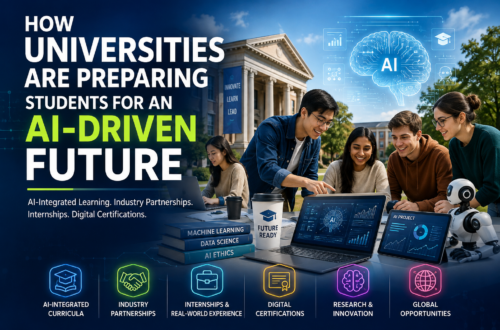
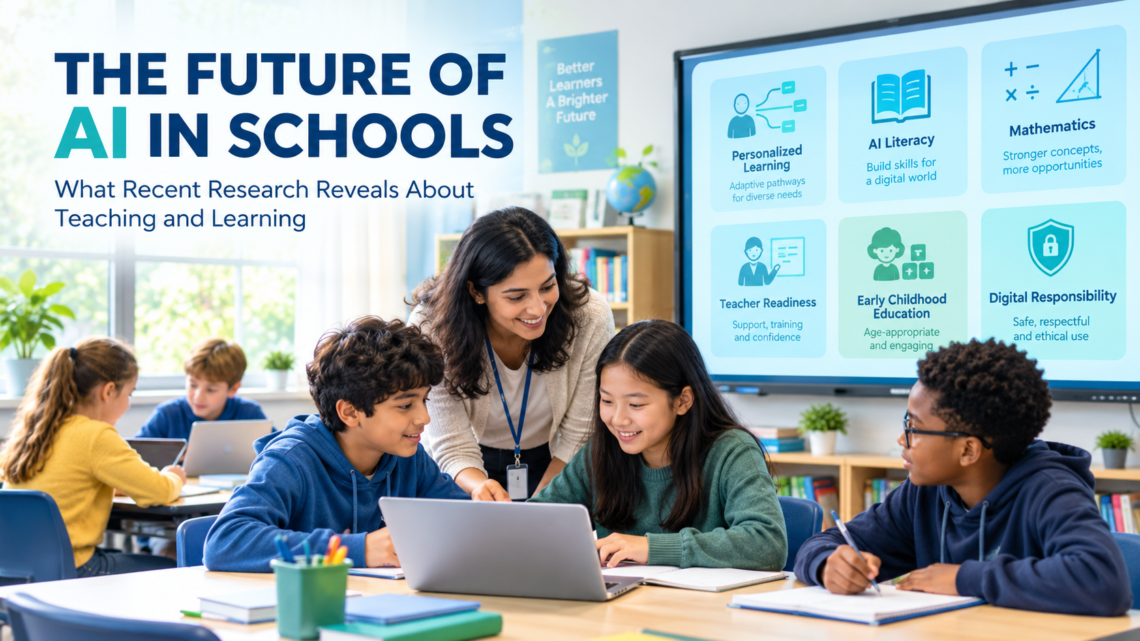
The article explores the review’s reported scope of 1,154 research publications, the major themes shaping AI in school education, and what these developments could mean for students, teachers, parents, and education policymakers. It also distinguishes emerging opportunities from questions that still require stronger evidence.

Introduction: How Artificial Intelligence Is Changing School Education
Artificial intelligence (AI) is becoming an important part of conversations about the future of education. From personalized learning platforms and intelligent tutoring systems to conversational chatbots and automated feedback tools, AI technologies are creating new possibilities for how students learn and teachers teach. These developments raise an important question: how can schools use AI to improve educational experiences while protecting the human values at the heart of learning?
A research review published on October 21, 2026, in Discover Education, a journal from Springer Nature, offers a broad perspective on this transformation. Titled Mapping Research Trends in Artificial Intelligence for K–12 Teaching and Learning: A Scientometric Analysis, the study examines 1,154 research publications indexed in Scopus and published between 2016 and May 2026. Researchers Diana Teresa Parra-Sánchez and José Joaquín Uribe-Arengas used scientometric analysis to identify major research themes, influential publications, and emerging directions in school-based AI education.
The review identifies four major research clusters: AI literacy, large language models, early childhood education, and the wider educational and ethical implications of AI in K–12 settings. It also highlights the growing importance of teacher readiness, curriculum development, responsible AI use, and student-centred learning.
The findings suggest that research on AI in schools is moving beyond questions about whether technology can be introduced into classrooms. Increasingly, researchers are examining how AI should be taught, how educators can use it responsibly, and how schools can ensure that technological innovation supports meaningful learning.
What the Latest Research Reveals About AI in Schools
The review provides a map of the research landscape rather than a direct experiment comparing AI-assisted classrooms with conventional teaching. Its purpose is to understand how scholarship has developed, which themes have attracted attention, and where new research directions are emerging.
A review of 1,154 research publications
The researchers examined a validated collection of 1,154 Scopus-indexed documents covering the period from 2016 to May 2026. They used citation networks, clustering methods, and citation-burst analysis to investigate the structure and evolution of the field.
Their findings indicate that academic interest in AI for school education increased rapidly after 2020, with further attention following the emergence of generative AI technologies.
This growth reflects the expansion of research into intelligent tutoring systems, adaptive learning environments, educational robotics, conversational AI, AI literacy curricula, and the ethical consequences of introducing automated systems into schools.
However, an important distinction must be made: an increase in research publications does not automatically demonstrate that AI improves learning outcomes. Scientometric analysis reveals patterns in academic attention and influence. Establishing whether a particular technology improves achievement requires separate empirical studies.
The review is therefore valuable because it identifies the questions researchers are asking and helps educators understand how the field is evolving.
Four major themes shaping the future
The study identifies four broad research clusters.
AI literacy focuses on helping students and teachers understand artificial intelligence, its capabilities, its limitations, and its ethical implications.
Large language models examine conversational systems and generative AI, including their potential roles in assessment, feedback, educational content creation, and classroom learning.
Early childhood education explores developmentally appropriate ways to introduce AI concepts to younger learners through play, inquiry, visual activities, and interactive experiences.
The wider K–12 context addresses broader questions involving educational policy, curriculum transformation, ethics, student agency, and the social consequences of AI adoption.
Together, these themes show that AI education is not simply about teaching children to operate digital tools. It also involves developing critical thinking, digital citizenship, responsible decision-making, and an understanding of how automated systems influence everyday life.
Personalized Learning: Can AI Support Individual Student Needs?
One of the most promising applications of AI in education is personalized learning. In a traditional classroom, teachers often work with students who have different levels of prior knowledge, learning speeds, interests, and support requirements. Providing individual attention to every student can be difficult, particularly in large classrooms.
AI-supported learning platforms may help address some of these challenges by adjusting activities, offering additional practice, and identifying topics that require further explanation.
Learning at an appropriate pace
Imagine a mathematics classroom where students are learning fractions. Some students understand the concept quickly, while others struggle to compare fractions with different denominators.
An adaptive learning platform could offer additional exercises to students who need practice while presenting more challenging problems to those who have mastered the basics.
A similar approach could be used in science, language learning, and introductory programming. Students could receive different exercises based on their progress instead of following exactly the same sequence of activities.
Such systems may help teachers identify learning gaps earlier and allocate classroom time more effectively.
Nevertheless, the quality of personalization depends on the quality of the educational design. An AI system can misinterpret a student’s difficulty, recommend inappropriate activities, or mistake a correct answer for genuine understanding.
Teachers should therefore review learning recommendations and combine automated assessments with classroom observation, discussion, and independent work.
Immediate feedback and additional practice
Feedback is an essential part of learning. Students need to understand not only whether an answer is correct but also why a particular approach works or fails.
AI systems can provide explanations, hints, examples, and additional practice shortly after a student submits an answer. This may help learners identify mistakes before they become persistent misunderstandings.
For example, a student solving an algebra equation might receive a prompt explaining that the same operation must be applied to both sides of the equation.
However, feedback must be accurate and age-appropriate. Generative AI systems can produce convincing explanations that contain mathematical, scientific, or factual errors.
Schools should encourage students to verify important information, compare AI explanations with trusted learning materials, and ask teachers when something appears inconsistent.
The goal should be to use immediate feedback to strengthen understanding, not to encourage students to accept every automated answer.
AI Literacy: Why Students Must Understand Artificial Intelligence
One of the most important findings of the review is the prominence of AI literacy as a research theme.
AI literacy refers to the knowledge and skills needed to understand, evaluate, and responsibly interact with artificial intelligence. It includes more than knowing how to enter a prompt into a chatbot.
Students need to understand what AI systems can do, how they may produce errors, why data matters, and how automated decisions can affect individuals and communities.
Moving beyond basic computer skills
Traditional digital literacy helps students use computers, search for information, communicate online, and create digital content. AI literacy extends these abilities by introducing the distinctive characteristics of intelligent systems.
Students should learn that AI tools generate outputs from patterns in data and computational processes. They should also understand that an AI-generated response is not necessarily correct, neutral, complete, or appropriate.
For example, a chatbot might provide an incorrect historical date, generate a misleading scientific explanation, or produce different recommendations depending on the wording of a question.
Students who understand these limitations are better positioned to question outputs rather than treating AI as an unquestionable authority.
AI literacy can be introduced gradually. Younger pupils might explore simple classification activities, while older students could examine machine learning, data quality, algorithmic bias, and the responsible use of generative AI.
Teaching ethics alongside technology
AI education should also address privacy, fairness, transparency, copyright, and accountability.
Students need to understand why personal information should not be entered into unapproved systems, why AI-generated images and text may require disclosure, and why automated decisions should be examined critically.
Classroom activities can make these ideas practical. Teachers might ask students to compare AI-generated explanations with textbook information, identify possible stereotypes in generated examples, or discuss whether a particular use of student data is appropriate.
These exercises help students develop responsible habits before they encounter increasingly sophisticated AI applications.
The broader objective is to prepare learners not only to use AI but also to participate thoughtfully in a society where AI-supported decisions are becoming more common.
Generative AI and Large Language Models in the Classroom
Large language models have become a prominent topic in educational research because they can generate text, explain concepts, suggest ideas, and respond to questions in conversational language.
These capabilities offer potential benefits for students and teachers, but they also introduce new challenges involving accuracy, independent thinking, assessment, and academic integrity.
Supporting writing and language development
AI tools can help students brainstorm ideas, organise paragraphs, identify grammatical mistakes, and explore alternative ways of expressing a thought.
For language learners, conversational practice may provide opportunities to rehearse vocabulary, ask questions, and receive additional examples.
Teachers can also use AI to generate reading passages at different difficulty levels, suggest discussion questions, or create practice exercises.
However, there is a significant difference between using AI to improve a student’s writing and allowing AI to complete the entire assignment.
When students submit generated work without understanding it, teachers may find it difficult to assess their actual abilities. Students may also lose opportunities to practise planning, drafting, revising, and developing their own arguments.
A responsible classroom approach should make the purpose of AI assistance explicit. Students might be allowed to use a tool for brainstorming or grammar feedback while being required to write the final response independently and explain their decisions.
Helping students understand difficult concepts
Conversational AI can provide another explanation when a textbook description is confusing. A student studying photosynthesis, for example, might request a simpler explanation, an analogy, or a step-by-step summary.
Students can also ask follow-up questions instead of relying on a single explanation.
Nevertheless, teachers should remind learners that fluent language does not guarantee factual accuracy. An AI system may omit important details, misunderstand the question, or present an incorrect answer confidently.
For this reason, AI-generated explanations should be treated as learning resources that require evaluation.
A useful classroom practice is to ask students to check AI responses against textbooks, classroom notes, reliable educational websites, or teacher-provided materials. This encourages independent verification and strengthens research skills.
Rethinking homework and assessment
Generative AI challenges traditional approaches to homework because students may use automated tools to produce answers that appear to demonstrate understanding.
Schools can respond by designing assessments that evaluate reasoning and learning processes, rather than relying exclusively on polished final products.
Teachers might ask students to explain how they solved a problem, complete part of an assignment in class, discuss the sources they consulted, or revise an initial answer after receiving feedback.
These approaches do not require schools to abandon written assignments. Instead, they help educators understand what students know and how they reached their conclusions.
Clear rules are essential. Students should know when AI assistance is permitted, when it must be disclosed, and which activities must be completed independently.
Early Childhood Education: Introducing AI at the Right Age
The review identifies early childhood education as another important research cluster. This is significant because younger children have different developmental needs from secondary school students.
Early AI education should prioritise exploration, curiosity, communication, and age-appropriate activities rather than extensive screen exposure or complicated technical instruction.
Learning through play and discovery
Young children can begin exploring AI-related ideas through simple games and hands-on activities.
For example, a teacher might ask children to sort pictures of animals according to visible characteristics. The class can then discuss how a computer might use examples to recognise patterns and why unusual examples may cause mistakes.
Simple robotics activities can introduce sequencing, instructions, and problem-solving. Children might work together to guide a small robot through a route using a sequence of commands.
These activities can develop computational thinking without requiring children to understand advanced mathematics or programming.
They also create opportunities for collaboration. Children can predict outcomes, test ideas, discuss errors, and revise their approaches.
Protecting children’s development and well-being
AI tools designed for younger learners require particular care.
Children may not fully understand data collection, advertising, privacy, or the difference between a conversational machine and a human relationship. They may also be more vulnerable to inappropriate content or misleading responses.
Schools and parents should therefore prioritise age-appropriate tools, adult supervision, privacy protection, and clear boundaries around technology use.
Digital activities should complement play, reading, physical movement, creative expression, and direct interaction with other people.
The purpose of early AI education is to build curiosity and foundational understanding, not to replace the experiences through which children develop language, social skills, emotional awareness, and independence.
Teachers Remain Central to Successful AI Integration
Although AI technologies can automate certain tasks, teachers remain essential to the educational process. The review highlights teacher readiness and human-centred integration as increasingly important research directions.
This emphasis challenges the idea that simply providing schools with AI software will automatically produce better learning.
Teachers must understand how a technology works, where it is useful, when it may be unreliable, and how it fits the curriculum.
Why teacher training matters
Teachers need practical professional development that combines technical knowledge with instructional judgment.
Training should help educators evaluate AI-generated material, design suitable classroom activities, protect student information, and recognise potential bias.
It should also provide opportunities to experiment with tools, discuss challenges with colleagues, and develop classroom policies that reflect the needs of their students.
For instance, a science teacher might learn how to use AI to create differentiated practice questions while checking the accuracy of each question and answer. An English teacher might explore AI-assisted feedback while ensuring that students still develop their own writing skills.
Professional development should be ongoing rather than limited to a single introductory workshop. AI tools change quickly, and educators need opportunities to evaluate new features and reconsider existing practices.
Reducing administrative pressure without losing professional judgment
AI may assist teachers with drafting lesson plans, generating quiz questions, organising learning resources, and preparing differentiated activities.
These uses could reduce some routine workload and free up time for activities that require human attention, such as supporting struggling students, discussing complex ideas, and building relationships with families.
However, automated outputs must be reviewed before they are used. AI-generated lesson plans may not reflect the local curriculum, classroom resources, students’ language needs, or accessibility requirements.
Teachers must remain responsible for instructional decisions and the materials they provide to learners.
AI should strengthen professional judgment rather than replace it.
Ethical Challenges: Privacy, Bias, Accuracy, and Trust
The expansion of AI in school education brings significant ethical responsibilities. The review highlights the importance of responsible implementation, transparency, and attention to the wider consequences of educational technology.
Protecting student data
AI-powered platforms may collect information about student answers, learning progress, behaviour, or interactions with digital tools.
Schools should understand what information a system collects, how long it is retained, who can access it, and whether it is used for purposes beyond teaching.
Personal information should not be entered into unapproved AI services. Schools should assess providers carefully and establish appropriate safeguards for student data.
Children require particularly strong protection because they may not fully understand the long-term implications of sharing personal information online.
Addressing bias and unequal treatment
AI systems can reproduce patterns and biases present in their training data or design. This may affect the examples they generate, the feedback they provide, or the recommendations they make.
For example, an educational system may perform differently for students using different languages or dialects. Automated tools may also produce examples that reinforce stereotypes.
Teachers and school leaders should examine whether tools work fairly across the student population and provide alternatives when they do not.
Students should not be labelled or restricted solely because an algorithm predicts that they are likely to struggle.
Educational decisions that significantly affect a child’s opportunities require human oversight, contextual understanding, and appropriate procedures for review.
Understanding the limits of AI-generated information
AI systems can generate fabricated references, incorrect explanations, outdated information, or misleading summaries.
These limitations are particularly important in education because students may lack the subject knowledge needed to recognise mistakes.
Schools should teach verification as a routine skill. Students can compare claims with trusted sources, check calculations independently, and explain why they believe an answer is reliable.
Teachers should also evaluate AI-generated educational content before sharing it with students.
Trust in AI should be conditional on evidence and appropriate safeguards, not based simply on the confidence or fluency of the system’s responses.
The Digital Divide: Will Every Student Benefit Equally?
AI has the potential to expand access to learning support, but its benefits may not be distributed equally.
Some schools have reliable internet access, modern devices, technical support, and teachers who receive regular training. Others face shortages of computers, limited connectivity, large class sizes, or insufficient funding.
If access to effective AI tools depends on a student’s family income or school resources, existing educational inequalities could become more pronounced.
Infrastructure and affordability
Schools need more than an internet connection to integrate AI successfully. They also require appropriate devices, secure systems, technical maintenance, accessible software, and support for teachers.
Education authorities should consider the full cost of implementation, including training, subscriptions, data protection, and ongoing evaluation.
Where connectivity is unreliable, schools may need offline resources or alternative teaching methods that do not depend on continuous access to AI platforms.
AI should not become a requirement that disadvantages students who cannot afford personal devices or paid services.
Language and cultural inclusion
Educational AI tools may work better in some languages and cultural contexts than in others.
For multilingual communities, students may need explanations in their preferred language or learning resources that reflect familiar examples and local experiences.
Schools should assess whether AI tools adequately support regional languages, students with disabilities, and learners from different educational backgrounds.
In India, this consideration is particularly relevant because school systems serve students across many languages, regions, and socioeconomic circumstances.
AI implementation should be guided by local needs rather than assuming that a single platform will work equally well everywhere.
Equitable AI education requires investment in infrastructure, inclusive design, teacher development, and accessible alternatives.
What AI in Schools Means for Education Policy
The research review suggests that AI integration should be considered a curriculum, professional development, and governance issue—not simply a technology purchase.
Education policymakers need frameworks that help schools make informed decisions while allowing teachers to adapt practices to their classroom environments.
Developing clear school AI policies
Schools should define acceptable uses of AI for students, teachers, and administrators.
Policies should explain which activities permit AI assistance, which require independent work, how students should disclose AI use, and how privacy is protected.
Rules should also cover the use of AI-generated images and text, the verification of information, and the handling of suspected academic misconduct.
Policies work best when they are understandable and consistently applied. Students should learn why the rules exist instead of viewing them only as restrictions.
Schools should periodically review their policies as technologies and educational needs evolve.
Integrating AI literacy into the curriculum
AI literacy can be taught across several subjects rather than being restricted to computer science.
In mathematics, students can investigate patterns and test generated solutions. In science, they can evaluate explanations and consider how data informs predictions. In language classes, they can compare human-written and AI-generated texts. In social studies, they can examine misinformation, fairness, privacy, and the social consequences of automation.
These activities connect AI literacy to existing academic goals and encourage students to use technology critically.
Curriculum design should also distinguish between learning about AI and using AI as a learning aid. Students need both opportunities to understand the technology and guidance on using it appropriately.
Evaluating educational impact
Before adopting a tool widely, schools should establish what they want it to achieve.
Possible objectives include improving feedback quality, reducing teachers’ administrative workload, supporting students with learning difficulties, or strengthening AI literacy.
Evaluation should examine not only test scores but also student understanding, engagement, independent problem-solving, accessibility, privacy, and teacher workload.
Small-scale pilots can help schools identify problems before investing in large implementations.
Decisions should be based on evidence from actual educational settings rather than promotional claims or assumptions that newer technology is necessarily better.
What Future Research Needs to Investigate
The review provides a useful map of research trends, but it also highlights areas where further evidence is needed.
Long-term learning outcomes
Researchers need more longitudinal studies examining how AI-supported learning affects knowledge retention, independent thinking, creativity, and academic development over time.
A student may complete a task faster with AI assistance without necessarily understanding the underlying concept. Research should distinguish between immediate task performance and durable learning.
Differences between age groups and subjects
AI tools may affect younger children, adolescents, and older students differently. Their value may also depend on the subject, teaching method, and type of learning activity.
Future studies should examine which applications are effective for particular educational goals and under what conditions.
Teacher experiences and classroom realities
Research should investigate how educators incorporate AI into everyday teaching, how they manage inaccurate outputs, and what professional support they need.
Teacher perspectives are especially important because educational technologies operate within complex classroom environments, not in isolation.
Cultural diversity and educational inequality
More research is needed in underrepresented regions, multilingual classrooms, and schools with limited technological resources.
Studies should investigate whether AI-supported education reduces learning gaps or unintentionally widens them.
Student agency and independent thinking
Researchers should also examine how students interact with AI, how they evaluate its responses, and whether particular patterns of use encourage or discourage independent reasoning.
The aim should not be to maximise AI use. It should be to identify approaches that help students become knowledgeable, confident, and independent learners.
Practical Recommendations for Schools, Teachers, and Parents
The emerging research themes can be translated into practical steps for responsible AI adoption.
For school leaders: Begin with clear educational objectives, assess privacy and accessibility, and pilot tools before introducing them widely. Provide teachers with training and review outcomes regularly.
For teachers: Use AI to support lesson preparation, practice activities, and feedback where appropriate. Verify generated content, maintain meaningful student-teacher interaction, and design assessments that reveal genuine understanding.
For students: Treat AI as a learning assistant rather than an unquestionable source of truth. Verify information, protect personal data, follow school rules, and practise solving problems independently.
For parents: Discuss responsible technology use, encourage curiosity and critical thinking, and ensure that AI activities do not displace reading, physical activity, creative play, or family interaction.
For policymakers: Invest in equitable access, teacher development, student privacy, curriculum guidance, and independent evaluation. Establish safeguards that protect children while allowing schools to investigate useful innovations.
These recommendations reflect a common principle: educational technology should serve clearly defined learning goals and remain accountable to the needs of students.
Conclusion: A Human-Centred Future for AI in Schools
The future of AI in school education will depend less on the number of digital tools available and more on how effectively schools integrate them into teaching and learning.
The October 21, 2026, review in Discover Education maps a decade of research through 1,154 publications and identifies four major themes: AI literacy, large language models, early childhood education, and the broader educational and ethical implications of AI in K–12 settings. Its findings also highlight teacher readiness, curriculum development, responsible use, and human-centred approaches as important directions for the field.
These themes point toward a more comprehensive understanding of AI in education. Schools need to prepare students to understand artificial intelligence, use it critically, recognise its limitations, and make responsible decisions about its applications.
AI-supported personalization, rapid feedback, conversational learning tools, and automated preparation may offer valuable assistance. Yet their educational value depends on accuracy, thoughtful instructional design, appropriate oversight, and equitable access.
Teachers remain essential because education involves more than delivering information. It also requires encouragement, relationships, judgment, social development, and the ability to understand individual learners.
The most promising future is therefore not a school system in which AI replaces human teaching. It is one in which carefully evaluated AI tools support teachers, help students overcome learning barriers, and create more opportunities for meaningful educational experiences.
Ultimately, the goal should not be to build schools that use the most AI, but to build schools where AI is used responsibly to help every student learn, think critically, and grow.