

Category: Life Skills · Career Readiness
Academic marks have long been considered an important measure of student achievement. Good grades can demonstrate subject knowledge, discipline, and the ability to prepare for examinations. However, professional success requires more than memorising information and scoring well on tests. Employers also value people who can communicate clearly, work with others, solve unfamiliar problems, and make thoughtful decisions.
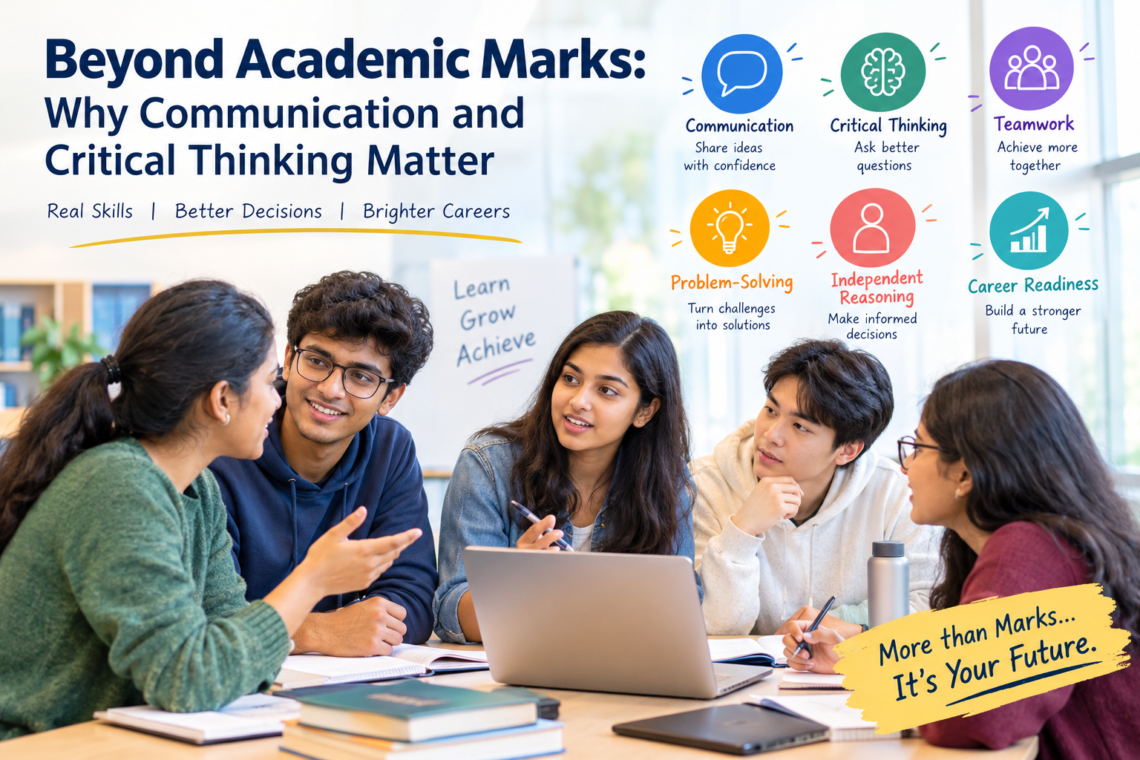
In a world shaped by technology, artificial intelligence, global collaboration, and rapidly changing job requirements, students need to develop practical skills alongside academic knowledge. Communication and critical thinking help bridge the gap between classroom learning and real-world responsibilities. These abilities prepare young people not only to find employment but also to adapt, contribute, and grow throughout their careers.
Why Academic Marks Are Not the Whole Story
Academic performance provides valuable evidence of learning, but it cannot capture every ability a student needs in professional life. A student may achieve excellent grades while struggling to explain an idea, participate in a group discussion, or handle a problem that has no textbook solution.
Similarly, a student with average marks may demonstrate creativity, leadership, emotional intelligence, and practical problem-solving abilities. These qualities can be valuable in workplaces where employees must collaborate, respond to changing circumstances, and turn knowledge into useful results.
This does not mean that academic marks are unimportant. Qualifications and examination results remain essential for many educational opportunities, competitive examinations, scholarships, and professions. Instead, students should understand that academic achievement and practical skills complement each other.
For example, a student studying computer science may understand programming concepts perfectly. However, developing a successful software project also requires understanding user needs, discussing requirements with teammates, explaining technical decisions, and identifying errors. Subject knowledge provides the foundation, while communication and critical thinking help transform that knowledge into practical outcomes.
The same principle applies to teachers, healthcare professionals, engineers, researchers, business managers, and government employees. Professional competence involves both knowing the right information and knowing how to use it effectively.
Communication Skills: Turning Knowledge into Impact

Communication is one of the most useful skills students can develop before entering the workforce. It involves expressing ideas clearly, listening carefully, asking relevant questions, writing effectively, and adapting messages to different audiences.
In professional environments, people regularly communicate with colleagues, managers, customers, clients, and other stakeholders. Even technically excellent work can lose its impact if the person responsible cannot explain its purpose, findings, or benefits.
The importance of presentations
Classroom presentations provide opportunities to practise speaking confidently, organising information, and explaining complex ideas in understandable language. Students learn how to introduce a topic, arrange key points, use visual aids, and respond to questions.
These experiences can prepare them for professional responsibilities such as project demonstrations, team meetings, interviews, training sessions, and business presentations.
For instance, a student presenting a research project must do more than read information from slides. They need to understand the subject, select relevant evidence, explain conclusions, and respond thoughtfully when someone challenges an argument.
Students can improve presentation skills by practising short talks, recording themselves, seeking constructive feedback, and gradually speaking before larger groups. Confidence develops through preparation and repeated practice rather than waiting until the fear of public speaking disappears.
Listening is as important as speaking
Effective communication is not simply about talking well. Listening helps students understand different perspectives, recognise misunderstandings, and respond appropriately.
In group discussions, students should practise listening without interrupting, asking clarifying questions, and summarising another person’s argument before disagreeing. These habits encourage respectful conversations and reduce unnecessary conflict.
Active listening is particularly valuable in professional settings because workplace problems often arise from unclear expectations or incomplete information rather than a lack of technical knowledge.
Written and digital communication
Professional life also requires clear emails, reports, proposals, documentation, and online messages. Students should learn to communicate professionally, organise information logically, and choose an appropriate tone for different situations.
Digital communication skills are increasingly important because teams may collaborate through online meetings, shared documents, project-management platforms, and messaging applications.
Students can develop these abilities by writing project summaries, preparing formal emails, documenting their work, and learning to distinguish reliable information from misleading online content.
Critical Thinking: Learning to Question, Analyse, and Decide

Critical thinking is the ability to examine information carefully, evaluate evidence, identify assumptions, compare possible explanations, and reach reasoned conclusions.
Rather than accepting every statement as true, critical thinkers ask questions such as: What evidence supports this claim? Are there alternative explanations? What information is missing? What could happen if this decision is made?
These questions are essential in a world where students encounter enormous amounts of information through social media, online publications, search engines, and AI-powered tools.
Moving beyond memorisation
Memorisation helps students remember facts, definitions, formulas, and important concepts. However, understanding becomes more powerful when students can apply knowledge to unfamiliar situations.
For example, a mathematics student may memorise a formula and correctly solve familiar examination questions. Critical thinking helps that student recognise when the formula applies to a new problem, identify relevant assumptions, compare methods, and check whether the answer makes sense.
Teachers can encourage this approach by asking students to explain why an answer is correct, compare alternative solutions, and describe how a concept could be applied in real life.
Students should also become comfortable with uncertainty. Not every question has an immediate or obvious answer. Learning to investigate a problem systematically is often more valuable than guessing quickly.
Evaluating information and avoiding misinformation
Critical thinking helps students distinguish facts, opinions, assumptions, and unsupported claims. This ability is particularly important when evaluating online content, scientific findings, advertisements, and AI-generated answers.
Students should examine the original source of information, check publication dates, compare credible sources, and look for evidence that supports or challenges a claim.
AI tools can help explain concepts and generate ideas, but their answers may contain errors or missing context. Students who think critically are better prepared to verify important information rather than accepting an answer simply because it sounds convincing.
Making better decisions
Professional decisions often involve competing priorities, limited resources, and uncertain outcomes. Critical thinking helps individuals identify the problem, collect relevant information, evaluate alternatives, consider risks, and justify their choices.
These habits are useful whether a graduate is planning a project, investigating a technical error, managing a budget, or deciding how to respond to a customer complaint.
Teamwork: Learning to Achieve More Together

Most professional environments depend on cooperation. Projects frequently involve people with different expertise, experiences, responsibilities, and working styles. Students who learn to collaborate during their education are better prepared to participate in these environments.
Teamwork is more than dividing an assignment into separate sections. It requires shared planning, clear responsibilities, mutual respect, accountability, and a willingness to solve disagreements constructively.
Understanding different perspectives
Students working in groups may discover that their classmates approach the same problem in different ways. One person may focus on data, another on creative ideas, and another on practical implementation.
Considering these perspectives can help a team develop better solutions than any individual might produce alone. It also teaches students to recognise that disagreement does not necessarily mean that someone is wrong or uncooperative.
Managing conflict constructively
Differences of opinion are natural in collaborative work. Students should learn to discuss disagreements respectfully, focus on evidence, identify shared objectives, and seek solutions that address the actual problem.
For example, if two students disagree about the structure of a presentation, they can compare their proposed approaches against the assignment requirements instead of treating the disagreement as a personal conflict.
Such experiences help develop patience, emotional awareness, negotiation, and conflict-resolution skills.
Building accountability and leadership
Successful teamwork depends on people completing their responsibilities and communicating when difficulties arise. Students can practise setting deadlines, tracking progress, supporting struggling teammates, and taking responsibility for mistakes.
Leadership does not always mean directing everyone else. Sometimes it means organising a meeting, encouraging a quieter teammate to contribute, or helping a group return to its objectives when discussions become unproductive.
These small experiences build habits that transfer naturally to professional projects and workplace relationships.
Problem-Solving: Applying Knowledge to Real-World Challenges

Problem-solving connects academic knowledge with practical action. In examinations, students are often given a clearly defined question and expected to produce an answer. In real life, the problem itself may be unclear, the available information may be incomplete, and several solutions may be possible.
Developing problem-solving skills helps students approach these situations with structure and confidence.
A practical approach to solving problems
Students can use a simple process whenever they face a challenge.
Identify the problem
Define what is going wrong and distinguish the main issue from its symptoms.
Gather relevant information
Collect facts, examine available evidence, and identify what remains unknown.
Compare possible solutions
Consider costs, benefits, risks, limitations, and alternative approaches.
Test and evaluate
Apply a solution, review the results, and improve the approach when necessary.
Consider a student team developing a website for a college project. The website works on one computer but fails on another. Instead of randomly changing the code, the students can reproduce the error, check browser compatibility, review the console messages, test possible explanations, and document the solution.
This approach teaches patience, logical reasoning, collaboration, and learning from mistakes.
Why failure can be educational
Students sometimes avoid difficult tasks because they fear losing marks or appearing unsuccessful. However, manageable failures can reveal weaknesses and provide valuable feedback.
When students test ideas, receive feedback, and revise their work, they learn to treat mistakes as information rather than as permanent judgments about their abilities.
The goal is not to celebrate every failure. It is to develop the ability to analyse what went wrong and make a better-informed next attempt.
Independent Reasoning: Developing Confidence in Your Own Judgement
Independent reasoning means forming conclusions through evidence and logical analysis rather than relying entirely on other people’s opinions.
Students encounter many sources of influence, including teachers, friends, online communities, social media personalities, and AI assistants. These sources can provide valuable guidance, but students also need to develop their own understanding.
Independent reasoning does not mean rejecting advice or assuming that personal opinions are always correct. It means evaluating advice carefully, understanding the reasons behind a conclusion, and being willing to revise a position when stronger evidence becomes available.
Asking better questions
Students can strengthen independent reasoning by asking questions that go beyond the expected answer. Why does a particular method work? What assumptions does it depend on? Would the result change under different conditions? What evidence would challenge this conclusion?
These questions encourage deeper learning and help students recognise connections between different subjects.
Building arguments with evidence
An effective argument contains a clear claim, supporting evidence, and logical reasoning that connects the two. Students can practise this skill through essays, classroom debates, research projects, and discussions about current issues.
They should also learn to distinguish a strong argument from a confident-sounding statement. A claim does not become reliable merely because many people repeat it.
Using AI without losing independent thought
AI tools can help students brainstorm, summarise information, practise interviews, and understand difficult topics. However, relying on generated answers without examining them can weaken opportunities to practise independent reasoning.
A better approach is to attempt a problem first, use AI to explore alternative explanations, verify important claims, and then explain the final answer in one’s own words.
This makes technology a learning partner rather than a replacement for thought.
Emotional Intelligence and Adaptability in Professional Life
Communication and critical thinking become even more effective when supported by emotional intelligence and adaptability.
Emotional intelligence includes recognising emotions, managing reactions, understanding other people’s perspectives, and responding constructively to difficult situations. These abilities help students handle feedback, disagreements, pressure, and professional relationships.
For example, a student receiving criticism on a project may initially feel disappointed. Instead of reacting defensively, they can identify which comments are useful, ask questions, and revise their work.
Adaptability is equally important because professional tools, industries, and job responsibilities change over time. Students who are willing to learn new skills, reconsider outdated assumptions, and seek feedback are better equipped to respond to change.
Together, these qualities support resilience, teamwork, and continuous professional development.
How Students Can Develop These Skills During College
Students do not need expensive courses or special facilities to develop communication and critical thinking. Regular classroom activities, independent projects, and everyday interactions can provide meaningful practice.

Practise speaking every week
Explain a concept from your course in two or three minutes. Record yourself, notice unclear explanations, and practise improving your delivery.

Participate in group discussions
Contribute ideas, listen carefully, ask questions, and summarise opposing viewpoints fairly before responding.

Complete practical projects
Build a small website, analyse a dataset, conduct a survey, prepare a research report, or develop a solution to a local problem.

Question what you read
Compare reliable sources, check evidence, identify assumptions, and explain why you agree or disagree with a conclusion.

Prepare for professional situations
Practise interviews, write professional emails, present project outcomes, and describe how you solved a real problem.
A simple weekly skill-building plan
Students can begin with a manageable routine that fits around their regular studies.
| Day | Practical activity | Skill developed |
|---|---|---|
| Monday | Explain a topic aloud for three minutes | Communication |
| Tuesday | Solve one unfamiliar problem | Critical thinking |
| Wednesday | Participate in a group discussion | Teamwork |
| Thursday | Compare two sources on the same issue | Independent reasoning |
| Friday | Write a professional email or short report | Written communication |
| Saturday | Work on a small practical project | Problem-solving |
| Sunday | Review progress and identify one improvement | Self-awareness |
Consistency matters more than completing every activity perfectly. Students should gradually increase the difficulty of their tasks as their confidence improves.
What Colleges and Educators Can Do
Students benefit most when educational institutions create opportunities to practise these skills alongside academic learning.
Teachers can introduce presentations, case studies, collaborative assignments, research activities, debates, and real-world problem-solving exercises. Assessment methods can reward not only correct answers but also the quality of reasoning, effective collaboration, and the ability to explain a process.
Colleges can also encourage internships, volunteering, entrepreneurship clubs, coding competitions, student-led research, and community projects. These experiences expose students to practical challenges that may not appear in textbooks.
Feedback is especially important. Students need clear explanations of what they did well, where their reasoning was weak, and how they can improve. A supportive learning environment allows them to ask questions and experiment without treating every mistake as a personal failure.
Employers can contribute by offering mentorships, internships, workplace projects, and opportunities for students to observe how professional teams communicate and make decisions.
The broader goal is to create a connection between what students learn and what they will be expected to do after graduation.
Conclusion: Success Requires Knowledge and Practical Skills
Academic marks remain valuable, but they represent only one part of a student’s development. Communication helps graduates express ideas, understand others, and collaborate effectively. Critical thinking enables them to evaluate evidence, question assumptions, and make reasoned decisions. Teamwork, problem-solving, independent reasoning, emotional intelligence, and adaptability help turn these abilities into practical professional competence.
Students can begin building these skills before graduation through presentations, group projects, research, practical assignments, and regular self-reflection. Colleges and educators can strengthen this process by making active learning and real-world application a meaningful part of education.
Ultimately, career readiness is not simply about how much a student knows. It is also about how effectively that student can use knowledge, learn from experience, communicate with others, and respond to new challenges. The strongest foundation for a successful career combines academic knowledge with the ability to think clearly, communicate confidently, and solve problems responsibly.