Artificial Intelligence (AI) is no longer a futuristic concept—it’s becoming a core part of how businesses operate, governments deliver services, and individuals interact with technology. As AI reshapes industries ranging from healthcare and finance to education and manufacturing, universities around the world are adapting their teaching methods to prepare students for an AI-driven workforce.
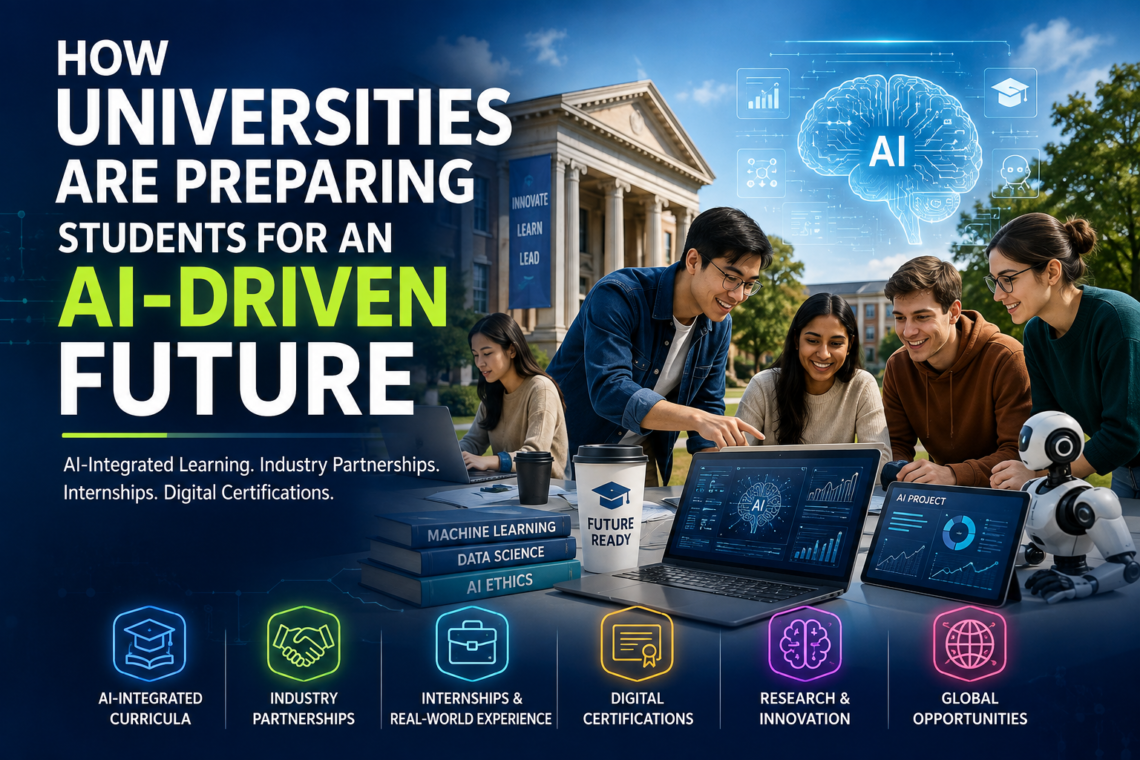
Modern universities are no longer focused solely on traditional degrees. Instead, they are integrating AI into academic programs, collaborating with leading technology companies, offering hands-on internships, and encouraging students to earn digital certifications that improve employability. These changes ensure graduates possess both technical expertise and essential human skills needed in the evolving job market.
🎓 AI-Integrated Curricula Across Every Discipline


One of the biggest transformations in higher education is the integration of AI into existing curricula. Previously, AI education was mainly limited to computer science departments. Today, universities recognize that AI literacy benefits students in nearly every field.
AI in Computer Science
Computer science students now study:
- Machine Learning
- Deep Learning
- Natural Language Processing (NLP)
- Computer Vision
- Robotics
- AI Ethics
- Large Language Models (LLMs)
Students gain practical experience by building AI applications, developing chatbots, training predictive models, and deploying AI-powered software.
AI in Business Programs
Business schools increasingly teach students how AI can improve:
- Marketing automation
- Customer analytics
- Financial forecasting
- Supply chain optimization
- Decision-making using predictive analytics
Graduates enter the workforce with a strong understanding of data-driven business strategies.
AI in Healthcare Education
Medical and healthcare students learn how AI assists in:
- Disease diagnosis
- Medical imaging
- Personalized treatment plans
- Drug discovery
- Patient monitoring
Future healthcare professionals are trained to collaborate with AI tools while maintaining ethical patient care.
AI in Law and Humanities
Even law and humanities programs include AI topics such as:
- AI regulations
- Intellectual property
- Digital privacy
- Responsible AI governance
- Ethical decision-making
This interdisciplinary approach prepares graduates for careers where AI intersects with public policy and society.
🤝 Strong Industry Partnerships


Universities increasingly partner with global technology companies to ensure students learn the latest industry practices.
These collaborations often include:
- Guest lectures from AI professionals
- Industry-sponsored research projects
- AI innovation labs
- Joint certification programs
- Campus hackathons
- Startup incubation centers
Students gain exposure to real-world AI applications rather than learning only theoretical concepts.
Benefits of Industry Collaboration
Students can:
- Solve actual business problems
- Learn industry-standard tools
- Build professional networks
- Receive mentorship
- Explore entrepreneurship opportunities
These partnerships also help universities regularly update curricula to match changing industry demands.
💼 Internship Programs Provide Practical Experience
Employers increasingly value practical experience alongside academic qualifications. Universities therefore encourage internships as an essential component of AI education.
Students may intern in:
- AI startups
- Software companies
- Banks
- Healthcare organizations
- Manufacturing firms
- Government technology departments
During internships, students work on projects involving:
- Data analysis
- AI model development
- Process automation
- Predictive analytics
- Customer service chatbots
- Business intelligence dashboards
This practical experience strengthens resumes and builds confidence before graduation.
📜 Digital Certifications Enhance Employability
Universities increasingly encourage students to earn industry-recognized digital certifications alongside their degrees.
Popular certification areas include:
- Artificial Intelligence
- Machine Learning
- Cloud Computing
- Data Analytics
- Cybersecurity
- Project Management
- Digital Marketing
- Python Programming
These certifications help students:
- Demonstrate practical skills
- Stand out during recruitment
- Learn emerging technologies quickly
- Stay updated after graduation
Many universities also integrate certification preparation directly into coursework.
🧠 AI Labs, Innovation Centers, and Research Opportunities
Many campuses now feature dedicated AI laboratories where students experiment with advanced technologies.
These innovation hubs often provide access to:
- High-performance computing
- Robotics equipment
- AI research datasets
- Cloud platforms
- Collaborative research projects
Students can participate in research involving:
- Autonomous vehicles
- Healthcare AI
- Climate modeling
- Smart cities
- Agricultural technology
- Financial technology
Hands-on research encourages creativity and prepares students for graduate studies or research careers.
🌍 Building Essential Human Skills
While AI automates many routine tasks, universities increasingly emphasize skills that remain uniquely human.
Students are encouraged to develop:
- Critical thinking
- Problem-solving
- Creativity
- Leadership
- Emotional intelligence
- Communication
- Teamwork
- Adaptability
Employers consistently value these abilities because successful professionals will increasingly collaborate with AI systems rather than compete against them.
💻 AI Tools Become Everyday Learning Assistants
Students increasingly use AI-powered educational tools to improve learning efficiency.
Common applications include:
- Personalized tutoring
- Coding assistance
- Language translation
- Research support
- Writing feedback
- Study planning
- Practice quizzes
- Data visualization
Universities also teach responsible AI usage by addressing topics such as academic integrity, citation practices, bias, and privacy.
🚀 Entrepreneurship and Startup Support
Many universities have established entrepreneurship centers focused on AI innovation.
Students receive support through:
- Startup incubators
- Business mentoring
- Seed funding competitions
- Pitch events
- Innovation challenges
- Accelerator programs
These initiatives encourage graduates to create AI-powered businesses instead of solely seeking traditional employment.
🌐 Preparing Students for Global Careers
AI is a global technology, and universities increasingly offer international opportunities such as:
- Student exchange programs
- Virtual global classrooms
- International AI competitions
- Collaborative research projects
- Cross-border internships
These experiences expose students to diverse perspectives and global best practices.
📈 Lifelong Learning Mindset
AI technologies evolve rapidly, making continuous learning essential.
Universities encourage lifelong learning by promoting:
- Micro-credentials
- Online learning platforms
- Professional workshops
- Alumni upskilling programs
- Continuous certification
Graduates understand that learning continues throughout their careers as AI advances.
Conclusion
Universities are transforming rapidly to prepare students for an AI-driven future. Through AI-integrated curricula, industry partnerships, practical internships, digital certifications, research opportunities, and entrepreneurship programs, higher education is becoming more aligned with the needs of the modern workforce.
Beyond technical expertise, institutions are also helping students develop critical thinking, creativity, ethical decision-making, and adaptability—skills that will remain valuable regardless of how AI evolves. Graduates who combine strong technical knowledge with human-centered abilities will be well-positioned to thrive in the next generation of careers.