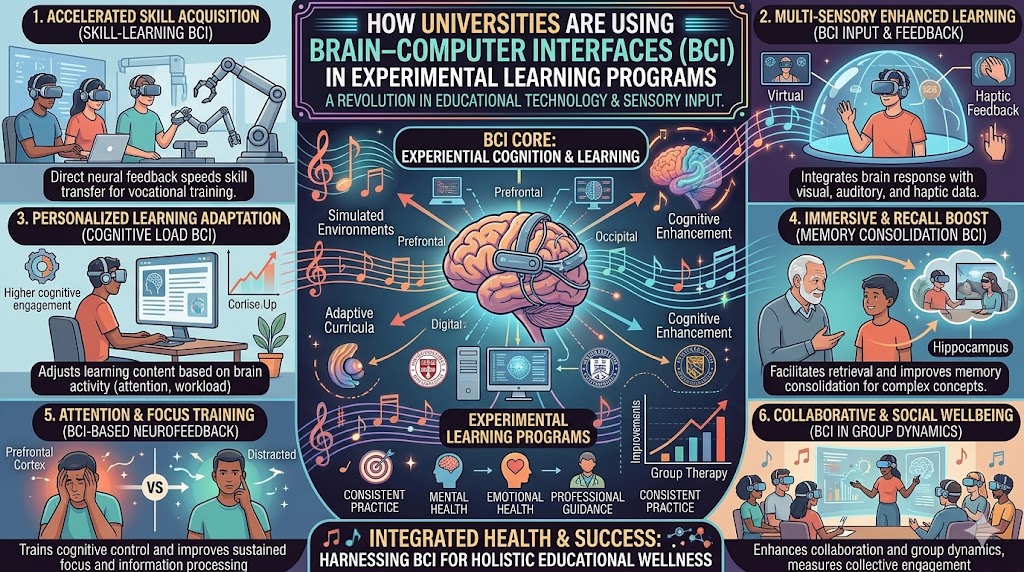
Universities are using Brain–Computer Interfaces in experimental learning programs to study cognition, build neuroadaptive classrooms, enable brain-controlled VR and robotics, and personalize education through real-time brain feedback.
Brain–Computer Interfaces (BCIs) are no longer confined to science fiction or medical rehabilitation labs. Today, leading universities around the world are integrating BCI systems into experimental learning programs, reshaping how students interact with technology, understand neuroscience, and even learn itself. These systems create a direct communication pathway between the brain and external devices, allowing thought-based control, neurofeedback-driven learning, and real-time cognitive monitoring.
As research expands across neuroengineering and AI, BCIs are becoming powerful educational tools—bridging neuroscience, machine learning, psychology, and human-computer interaction.
Understanding BCIs in an Educational Context
A Brain–Computer Interface is a system that translates brain activity into digital signals that can control computers, robots, or virtual environments. Most university programs use non-invasive EEG-based BCIs, which detect electrical signals from the scalp and interpret patterns associated with attention, intention, or motor imagery.
In experimental learning programs, BCIs are not just studied—they are actively used to:
- Track student cognitive engagement
- Enable hands-free interaction with simulations
- Provide real-time feedback on learning performance
- Train students in neurotechnology development
This transforms education from a passive experience into a closed-loop brain feedback system.
1. Neuroadaptive Learning Systems in Universities
One of the most promising applications is neuroadaptive learning, where educational systems adjust based on a student’s brain activity.


In these setups, EEG headsets measure signals such as attention level, cognitive load, and fatigue. The system then adapts content in real time:
- Slowing down lessons when cognitive overload is detected
- Increasing difficulty when engagement is high
- Offering visual or audio cues based on brain activity
Universities use these systems in cognitive science and engineering labs to study how students learn best under different conditions. This creates a feedback loop between the brain and the curriculum—something traditional education cannot achieve.
2. BCI-Controlled Virtual Reality Classrooms
Virtual Reality (VR) combined with BCIs is becoming a major research focus in academic institutions. Instead of using controllers or keyboards, students can navigate and interact with simulations using only brain signals.


Common applications include:
- Medical students practicing surgery in VR using attention-based control
- Engineering students manipulating robotic arms via motor imagery
- Psychology students studying cognition inside immersive environments
For example, motor imagery BCIs allow users to imagine movement (like moving a hand), which the system translates into digital commands. This is widely used in labs to teach neural decoding principles and machine learning models behind BCIs.
3. Hands-Free Laboratory Training and Robotics
Engineering and neuroscience departments are increasingly using BCIs to control physical systems such as robots, drones, and prosthetic devices.


In these programs, students learn how brain signals can be converted into actionable commands:
- Controlling robotic arms using EEG signals
- Flying drones through concentration or imagined movement
- Testing assistive technologies for disabled users
This hands-on experience helps students understand signal processing, machine learning pipelines, and real-world limitations like noise and calibration issues.
4. Cognitive Research and Learning Behavior Studies
BCI systems are also used as research instruments to study how learning actually happens in the brain.
Researchers measure:
- Attention shifts during problem-solving
- Memory retention patterns
- Cognitive fatigue during long study sessions
- Emotional responses to difficulty levels
These insights allow universities to design better teaching strategies. For instance, if brain data shows that students consistently lose attention after 20 minutes, course structures can be redesigned to include breaks or interactive elements.
Some labs even use BCIs to compare traditional learning with AI-assisted or immersive learning environments, helping identify which methods produce stronger neural engagement.
5. Neurofeedback Training for Skill Development
Neurofeedback is one of the most practical uses of BCIs in education. It allows students to observe and train their brain activity in real time.


In these systems:
- Students see their brain waves displayed visually
- They learn to control focus, relaxation, or alertness
- Performance improves through iterative training
This approach is used in psychology, sports science, and even medical education to enhance cognitive control and emotional regulation.
6. Ethical and Technical Challenges in Academic Use
Despite its promise, BCI-based learning still faces serious challenges.
Technical limitations
- Brain signals are noisy and vary between individuals
- Systems require calibration for each user
- Real-time decoding accuracy is still limited
Ethical concerns
- Privacy of neural data (arguably the most sensitive data type)
- Risk of cognitive manipulation or surveillance
- Equity issues in access to advanced neurotechnology
Universities are actively developing ethical frameworks to ensure BCIs are used responsibly in educational settings.
7. The Future: From Experimental Labs to Smart Universities
The long-term vision is the emergence of neuro-integrated campuses, where BCIs are part of everyday learning infrastructure.
Future possibilities include:
- Exams that adapt difficulty based on brain stress levels
- Personalized curricula built from cognitive profiling
- Brain-controlled digital labs and AI tutors
- Fully immersive neuro-VR classrooms
Research already suggests that bidirectional BCIs—systems that not only read brain signals but also provide feedback to the brain—are becoming more feasible.
As these technologies mature, education could evolve into a deeply personalized system where learning is shaped not just by content—but by the brain itself.
Conclusion
Brain–Computer Interfaces are redefining the boundaries of experimental learning in universities. What began as a medical and rehabilitation tool is now becoming a foundational technology for next-generation education systems.
From neuroadaptive classrooms to brain-controlled robotics and cognitive research labs, BCIs are helping educators understand not just what students learn—but how their brains learn it.
While challenges around ethics, accuracy, and accessibility remain, the trajectory is clear: the future university may not just teach the brain—it may learn from it in real time.